Finding the right under-sink filter can make everyday drinking and cooking water cleaner, better tasting, and more convenient without a major installation project.
We compared 10 water filters under $300 across filtration type, capacity, certifications, maintenance, installation requirements, and long-term value so you can choose with confidence.
Best 10 Water Filters Under 300 Picks for 2026
Best Compact Pick
Waterdrop 10UA Under-Sink Filter

- Quick twist-and-lock installation
- 12-month municipal-water filter life
- Compact design with low-cost replacements
Best For: Renters and households filtering cold municipal tap water
Best Three-Stage Setup

- Sediment and two carbon filtration stages
- Twist-and-seal replacement design
- 12-month, 600-gallon filter capacity
Best For: Households wanting staged filtration with a dedicated faucet
Best Long-Life Value

- Up to five-year filter life
- Three-stage sediment, KDF, and carbon design
- No-drill direct-connect installation
Best For: Buyers seeking low-maintenance tap-water filtration
Best RO Upgrade
Waterdrop T3-C Tankless RO System

- 8-stage reverse-osmosis filtration
- 450 GPD tankless design with auto-flush
- Smart alerts and 2:1 pure-to-drain ratio
Best For: Households seeking compact, powered RO purification
Family RO Choice
EcoPure ECOP30 Reverse Osmosis System

- NSF-certified three-stage RO filtration
- Reduces lead, chlorine, cysts, chemicals, and TDS
- Tool-free encapsulated filter changes
Best For: Families wanting bottled-quality water for drinking and cooking
Zero-Waste UF Pick
Waterdrop TSU 0.01 Micron Under-Sink Filter
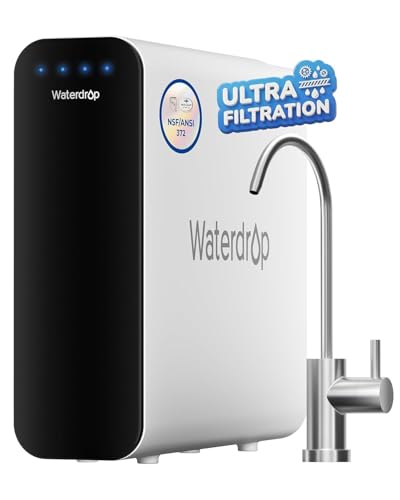
- 0.01-micron ultrafiltration reduces 30+ substances
- No wastewater, power, or drain line required
- Compact design with filter-life reminder lights
Best For: Municipal-water users with compact under-sink space
High-Flow Budget Pick
ICEPURE WFS5300A Under-Sink Filter

- 2.5 GPM tested flow rate at 60 PSI
- Up to 22,000-gallon filter capacity
- Quick installation and direct-faucet connection
Best For: Users wanting fast, high-flow cold-water filtration
Best Long-Life Direct-Connect Filter
Waterdrop 15UA Under-Sink Filter

- Up to 24,420 gallons or 24 months
- Quick direct-connect installation
- For municipal cold water only
Best For: Long-term, low-maintenance under-sink filtration
Best Compact Basic Purifier
Home Kitchen Ultrafiltration Water Filter

- Compact under-sink footprint
- Includes a dedicated faucet
- Claims reduction of scale and sediment
Best For: Space-conscious tap-water filtration
Best Feature-Rich UF System
Waterdrop TSB-UF Under-Sink Filter

- Nine-stage 0.01-micron ultrafiltration
- Includes dedicated stainless-steel faucet
- Does not reduce TDS
Best For: Municipal-water households wanting broad UF filtration
Best Compact Pick – Waterdrop 10UA Under-Sink Filter
If you want water filters under 300 that are compact and straightforward to install, the Waterdrop 10UA is a practical under-sink option for municipal cold tap water. Its twist-and-lock design, 12-month service life, and 0.75 GPM tested flow rate suit everyday drinking and cooking.
Best For: Renters and households seeking a compact, cold-water under-sink filter with low-cost replacement options.
Pros:
- Twist-and-lock design and push-to-connect fittings support quick installation and replacement.
- Designed for municipal tap water with a service life of up to 12 months.
- Compact enough for kitchens, bathrooms, RVs, offices, and leased properties.
- Replacement filters are listed at less than $25.99 each in the supplied notes.
Cons:
- Only intended for cold municipal water, not hot water or well water.
- Faucet and pipe compatibility should be checked, especially for threaded connections.
The 10UA is a sensible choice when installation simplicity, compact sizing, and manageable ongoing filter costs matter more than reverse-osmosis purification.
Best Three-Stage Setup – Brondell H2O+ Coral UC300
Among water filters under 300, the Brondell H2O+ Coral UC300 stands out for shoppers who want a three-stage under-counter system with a dedicated faucet. Its sediment, pre-carbon, and carbon-block stages target particulates, chlorine, VOCs, odors, and certain heavy metals while retaining beneficial minerals.
Best For: Homes wanting staged carbon filtration, a dedicated chrome faucet, and annual filter changes.
Pros:
- Three-stage filtration combines sediment, carbon pre-filter, and carbon-block filtration.
- Replacement filters are designed for simple twist-and-seal installation.
- Filter-change indicator includes a replacement battery.
- Filters are designed to provide up to 12 months of use and a 600-gallon capacity.
Cons:
- The supplied notes describe this item as a replacement filter set for the Coral system, which is sold separately.
- Maximum listed flow rate is 0.5 GPM.
The UC300 makes the most sense for buyers who value layered carbon filtration and convenient maintenance, provided they confirm whether they need the complete system or replacement filters.
Best Long-Life Value – CuZn UC-200 Under-Sink Filter
For shoppers comparing water filters under 300, the CuZn UC-200 is appealing because its filter is rated for up to five years. The direct-connect, three-stage design uses micro sediment membranes, KDF-55, and coconut-shell carbon to improve tap-water taste and reduce listed impurities without removing beneficial minerals.
Best For: Buyers prioritizing a long replacement interval and simple installation under a kitchen or bathroom sink.
Pros:
- Five-year filtration life can reduce the frequency of replacement purchases.
- Three-stage design uses sediment filtration, KDF-55, and coconut-shell carbon.
- Direct-connect installation requires no drilling, with installation parts included.
- NSF/ANSI 42 components and materials are listed, with reductions for lead, chlorine, and PFAS compounds noted.
Cons:
- It does not reduce TDS; the supplied notes identify reverse osmosis as the method for that purpose.
- Performance is intended for faucet tap water rather than a whole-home installation.
The UC-200 is a strong value-oriented pick if minimizing maintenance is your priority and you do not need TDS reduction.
Best RO Upgrade – Waterdrop T3-C Tankless RO System
If you want water filters under 300 with reverse-osmosis purification, the Waterdrop T3-C offers an 8-stage, tankless design with a 0.0001 μm RO membrane. Its 450 GPD flow rating, smart filter alerts, automatic flushing, and 2:1 pure-to-drain ratio provide a feature-rich setup for households seeking more extensive filtration.
Best For: Households wanting tankless reverse osmosis, compact installation, and automated maintenance reminders.
Pros:
- Eight-stage filtration is designed to reduce heavy metals, chlorine, and PFOA/PFOS.
- Tankless design can save up to 70% of under-sink space compared with traditional tank systems.
- Smart alerts, automatic flushing, and an all-in-one cartridge simplify maintenance.
- 450 GPD flow and a 2:1 pure-to-drain ratio support faster, more water-efficient operation.
Cons:
- Requires an electrical connection to operate.
- Faucet installation requires drilling a countertop hole.
- Replacement intervals vary: six months for the CF filter, 12 months for the CB filter, and 24 months for the RO filter.
The T3-C is the most technology-focused option here, but its power requirement and countertop drilling make it better suited to homeowners or buyers comfortable with a more involved installation.
Family RO Choice – EcoPure ECOP30 Reverse Osmosis System
For shoppers comparing water filters under 300, the EcoPure ECOP30 is a practical under-sink reverse osmosis option for households that want bottled-quality water at the kitchen sink or refrigerator. Its NSF-certified three-stage system reduces sediment, chlorine taste and odor, cysts, lead, chemicals, and total dissolved solids.
Best For: Families seeking an under-sink RO system for drinking, cooking, coffee, and pet water.
Pros:
- NSF 42 and NSF 58 certifications support reduction of aesthetic impurities, TDS, and other contaminants.
- Encapsulated filters twist into place without tools, water shutoff, or direct contact with used filters.
- Includes color-coded tubing, push-in connectors, a storage tank, and a dedicated faucet.
- One-year warranty can be extended to a lifetime warranty with registration and regular filter replacements.
Cons:
- Installation requires space for the storage tank and dedicated faucet.
- The system is larger than a simple inline filter, measuring 9 x 20.4 x 14 inches.
The ECOP30 stands out when broad contaminant reduction and RO filtration matter more than the smallest installation footprint. Its tool-free filter design also helps simplify ongoing maintenance.
Zero-Waste UF Pick – Waterdrop TSU 0.01 Micron Under-Sink Filter
Among water filters under 300, the Waterdrop TSU is suited to municipal-water users who want compact, no-power filtration without wastewater. Its 0.01-micron ultrafiltration membrane reduces more than 30 substances while retaining essential minerals and maintaining a maximum flow rate of 1.05 GPM.
Best For: Compact kitchens with municipal tap water and limited cabinet space.
Pros:
- Three-stage filtration reduces chlorine, PFAS, taste, odor, and heavy metals while retaining minerals.
- Produces no wastewater and requires no power or drain line.
- Four-panel indicator lights help track filter replacement timing.
- Slim 4.68 x 13.97 x 14.81-inch design fits under crowded sinks.
Cons:
- Does not reduce TDS.
- Designed for municipal cold water, not hot water or well water.
- Separate faucet requires drilling into the countertop.
The TSU is a strong fit for buyers prioritizing mineral retention, compact dimensions, and water-saving operation. Confirm your water source and faucet-installation needs before buying.
High-Flow Budget Pick – ICEPURE WFS5300A Under-Sink Filter
For shoppers seeking water filters under 300 with quick installation and high flow, the ICEPURE WFS5300A offers a simple plug-and-play design. It connects to an existing cold-water faucet, delivers a tested 2.5 GPM flow rate at 60 PSI, and uses a high-capacity filter rated for up to 22,000 gallons with municipal water.
Best For: Homes, offices, RVs, and kitchens needing straightforward cold-water filtration without a separate faucet.
Pros:
- Installation is designed to take less than three minutes, with filter changes taking about two seconds.
- NSF/ANSI 42 testing supports reduction of chlorine, taste, and odor; NSF/ANSI 372 indicates lead-free materials.
- High tested flow rate of 2.5 GPM at 60 PSI.
- Connects directly to the original faucet and fits 1/2-inch or 3/8-inch female NPT cold-water lines.
Cons:
- For cold-water lines only.
- Connection compatibility should be confirmed if your plumbing uses a different thread type.
- Its filtration claims focus on chlorine, taste, odor, and impurities rather than reverse-osmosis-level TDS reduction.
The WFS5300A is appealing when fast setup, strong flow, and long replacement intervals are priorities. It is best matched with compatible municipal cold-water plumbing and buyers who do not need a dedicated faucet.
Best Long-Life Direct-Connect Filter – Waterdrop 15UA Under-Sink Filter
For shoppers comparing water filters under 300, the Waterdrop 15UA is a practical under-sink option for municipal cold tap water. Its direct-connect design is built for quick installation, while the high-capacity filter is rated for up to 24 months or 24,420 gallons under stated conditions.
Best For: Households wanting a long-lasting under-sink filter for municipal water without adding a separate faucet.
Pros:
- Reduces chlorine, taste and odor, lead, PFOA/PFOS, heavy metals, sediment and other listed impurities.
- Installs in under three minutes with push-to-connect fittings and supports 3/8-inch and 1/2-inch connections.
- Offers a tested flow rate of 0.75 gallons per minute at 60 psi and keeps essential minerals.
- Uses BPA-free and lead-free materials and carries listed IAPMO certifications for NSF/ANSI 42 and 372.
Cons:
- Designed for municipal cold water only; it is not suitable for well water or hot water.
- The larger filter housing may require careful measurement of the under-sink space.
- Replacement filter WD-RF15 must be purchased separately.
The 15UA stands out when low-maintenance ownership and simple installation matter most. Confirm cabinet clearance and water compatibility before choosing it.
Best Compact Basic Purifier – Home Kitchen Ultrafiltration Water Filter
Among water filters under 300, this Home Kitchen purifier offers a compact under-sink setup for tap water. Its supplied specifications list a 10.63-by-5.2-by-10.24-inch footprint, a one-liter capacity and an included faucet, making it worth considering where installation space is limited.
Best For: Users seeking a compact under-sink purifier with a dedicated faucet and basic contaminant-reduction features.
Pros:
- Designed to reduce scale, chlorine, heavy metals, rust and sediment according to the supplied product claims.
- Includes a faucet for dedicated drinking-water dispensing.
- Compact dimensions may suit smaller under-sink cabinets.
- Can help reduce reliance on bottled water and associated plastic waste.
Cons:
- The supplied information does not specify filter lifespan, flow rate or replacement-filter details.
- The listing describes the system as ultrafiltration while also listing reverse osmosis as the purification method, so the exact configuration should be verified.
- Its one-liter stated capacity may be less suitable for high-volume household use.
This model may fit buyers prioritizing a small footprint and included faucet, but the limited specification details make it especially important to confirm filtration performance and maintenance requirements before purchase.
Best Feature-Rich UF System – Waterdrop TSB-UF Under-Sink Filter
For shoppers comparing water filters under 300, the Waterdrop TSB-UF combines a 0.01-micron ultrafiltration membrane with multiple filtration stages. It includes a dedicated lead-free faucet, supports common under-sink tubing sizes and is designed for municipal cold tap water.
Best For: Households wanting ultrafiltration, a separate drinking-water faucet and broad listed impurity reduction.
Pros:
- Its nine-stage system is designed to reduce chlorine, taste and odor, fluoride, heavy metals, rust, sediment, sand, silt and other listed impurities.
- Includes a lead-free brushed stainless-steel faucet and supports a fast, steady flow.
- Installs in about three minutes, with filter changes designed to take about three seconds.
- Includes components for 3/8-inch and 1/2-inch connections and uses a larger accordion-style filtration surface for anti-clogging performance.
Cons:
- It does not reduce TDS.
- It is intended for municipal water and should not be used with hot water; well-water use requires suitable pre-filtration.
- Filter life varies by water quality and usage, with individual stages listed at roughly six to 12 months.
The TSB-UF is a strong choice when you want a dedicated faucet and more extensive staged filtration than a basic direct-connect unit. Its operating limits and TDS limitation should be acceptable before purchase.
How We Picked the Best Water Filters Under 300
We focused on under-sink systems priced below $300 and compared the features that matter most in daily use. Our evaluation considered filtration technology, contaminant-reduction claims, independent certifications, filter life, flow rate, installation requirements, replacement-filter costs, and overall practicality.
The selection includes straightforward carbon filters, ultrafiltration systems, and reverse osmosis units. Because each technology solves a different problem, we prioritized clear use cases rather than treating every model as interchangeable. Certification details should always be verified against the latest manufacturer documentation, especially when shopping for reduction of specific contaminants.
Quick Comparison
Best for simple taste and chlorine improvements: Carbon-based systems such as the Waterdrop 10UA, ICEPURE WFS5300A, and Waterdrop 15UA are generally compact and easier to install than RO systems.
Best for fine-particle filtration without typical RO wastewater: Ultrafiltration models, including the Waterdrop TSU, TSB-UF, and comparable direct-drinking systems, can provide tighter filtration while preserving many minerals.
Best for broad dissolved-contaminant reduction: Reverse osmosis systems such as the Waterdrop T3-C and EcoPure ECOP30 are the strongest fit when reducing TDS or contaminants such as lead is a central priority. They usually require more components, maintenance, and installation planning.
Key Buying Factors for Water Filters Under 300
Choose the Filtration Technology First
Carbon filtration is a practical choice for chlorine, odors, and taste. Ultrafiltration uses a finer membrane and can target smaller particles while retaining minerals. Reverse osmosis offers the most comprehensive dissolved-solids reduction, but it may produce wastewater and often needs a drain connection, storage tank, or power depending on the design.
Check Certifications and Exact Claims
Look for NSF/ANSI certifications that match the contaminant you want reduced. A certification for chlorine or aesthetic effects does not automatically confirm lead, fluoride, bacteria, or TDS reduction. If your water has a known issue, use a current water-quality report or certified lab test to guide your choice.
Calculate Ongoing Costs
Compare stated filter capacity with replacement prices and replacement intervals. A system with a low purchase price may cost more over time if cartridges are expensive or replaced frequently. Also check whether replacement filters are readily available.
Confirm Fit and Installation Needs
Measure the cabinet space, identify the cold-water line connection, and check whether a dedicated faucet is included. RO systems may need electricity, a drain connection, and more room than compact inline filters. Verify connector sizes before purchasing.
Who Should Buy Which Water Filters Under 300?
Choose a compact carbon system if you want better-tasting municipal water, simple installation, and low maintenance. These are often the best value for renters or households without a specific contamination concern.
Choose ultrafiltration if you want finer filtration while keeping minerals in the water and avoiding the typical wastewater associated with RO. It is a useful middle ground for many homes.
Choose reverse osmosis if testing shows elevated dissolved contaminants or you specifically want substantial TDS reduction. Be prepared for more installation work, replacement parts, and potentially slower dispensing.
Before ordering, match the system to your water source, cabinet layout, household usage, and maintenance budget. The best water filter is the one whose certified performance and ongoing upkeep fit your actual needs.