When power, plumbing, or safe tap water is unavailable, a gravity water filter can provide drinking water without electricity, pumps, or complicated setup. The best option depends on how much water you need, how portable the system must be, and which contaminants the filter is designed to reduce.
We compared 10 gravity-fed systems ranging from compact personal filters to larger stainless-steel and bag-based setups. Use the guide below to match capacity, filtration performance, durability, and maintenance requirements to your emergency plan.
Best 10 Gravity Water Filters for Emergencies Picks for 2026
Best Countertop Emergency Filter
Purewell 3-Stage 2.25-Gallon System

- 0.01-micron UF membrane with carbon and silver-ion filtration
- No electricity required; includes stand and spigot
- Two filters rated for up to 6,000 gallons combined
Best For: Home emergency storage and countertop use
Best Large-Capacity Camping Filter

- 10-liter reservoir for groups and basecamps
- 1.75-liter-per-minute gravity flow without pumping
- Removes bacteria, protozoa, dirt, and debris
Best For: Group camping and portable emergency kits
Best Group Emergency Filter

- Separate four-liter dirty and clean reservoirs
- Filters four liters in about 2.5 minutes
- Rated for bacteria and protozoa reduction
Best For: Family camping and portable group preparedness
Best Compact Versatile Filter
LifeStraw Peak Compact 3-Liter

- Protects against bacteria, parasites, and microplastics
- Works as a gravity system, squeeze bottle, straw, or bottle filter
- Lightweight 3-liter design for portable kits
Best For: Solo travel, hiking, and compact emergency kits
Best Adjustable-Setup Pick

- 0.1-micron hollow-fiber and carbon filtration
- Multiple setup and bottle-connection options
- Replaceable hollow-fiber and carbon filters
Best For: Portable emergency kits, backpacking, and flexible personal use
Best Long-Life Straw System
Waterdrop Gravity Filter Straw
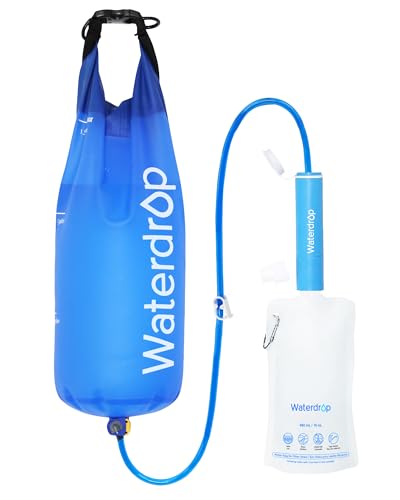
- 1.5-gallon gravity-fed water bag included
- Listed capacity up to 1,400 gallons
- Backwashable straw with 700 ml/min flow
Best For: Outdoor use and emergency kits needing extended filter capacity
Best Large-Capacity Emergency Bag

- 10-liter collapsible storage and filter bag
- Integrated 0.1-micron gravity filter
- Works without power or pumps
Best For: Disaster relief, shelters, field teams, and larger emergency kits
Best Portable Pick
VFX All-in-One Gravity Water Filter

- Includes 3L bladder, bag, and backflush syringe
- No chemicals or electricity required
- Flow rate up to 1L per minute
Best For: Solo emergency kits and portable outdoor use
Best Large-Reservoir Value
2-Gallon Gravity Filter System

- 2-gallon reservoir for group hydration
- 0.1-micron hollow fiber filter
- Up to 600ml per minute
Best For: Basecamps, RV travel, and small-group emergency use
Best Family-Capacity System

- 6L capacity for three to six people
- Four-stage filtration with carbon and hollow fiber
- Filter rated up to 1,320 gallons
Best For: Family camping and larger emergency water supplies
Best Countertop Emergency Filter – Purewell 3-Stage 2.25-Gallon System
For households seeking gravity water filters for emergencies, the Purewell 3-Stage system is a countertop option that needs no electricity. Its 2.25-gallon, two-chamber design uses a 0.01-micron hollow-fiber UF membrane, silver ion membrane, and activated carbon block to reduce chlorine and intercept sediment, rust, organic matter, and some heavy metals.
Best For: Home emergency storage, countertop use, and indoor or outdoor situations where electricity may be unavailable.
Pros:
- NSF/ANSI 42 and 372 certifications are supplied for the filter system.
- Gravity operation requires no electricity.
- Includes two filters, a stainless-steel stand, and spigot.
- Each filter is rated for up to 3,000 gallons, with replacement recommended every six months.
Cons:
- Its 2.25-gallon capacity is smaller than group-camping systems.
- The filter does not lower TDS.
- The manufacturer warns not to refill the upper chamber when the lower chamber is full because leakage can occur.
Purewell is most practical when you want a sturdy, non-electric home setup rather than a lightweight trail filter. Its stainless-steel construction and included stand add convenience, while the refill and maintenance instructions require attention during emergency use.
Best Large-Capacity Camping Filter – MSR AutoFlow XL 10-Liter
The MSR AutoFlow XL is a strong fit for gravity water filters for emergencies when portability and higher-volume output matter. Its 10-liter reservoir filters water at up to 1.75 liters per minute without pumping and is designed to remove bacteria, protozoa, dirt, and debris.
Best For: Larger backpacking groups, basecamps, and emergency kits that need a lightweight, high-capacity filter.
Pros:
- 10-liter capacity supports group use.
- Filters without pumping at a stated rate of 1.75 liters per minute.
- Rated to remove 99.9999% of bacteria and 99.9% of protozoa.
- Weighs 12 ounces, packs down to 8 by 4 inches, and includes a three-year limited warranty.
Cons:
- It is a backcountry-style system rather than a rigid countertop dispenser.
- The supplied details list a battery-powered power source, despite the filter operating through gravity without pumping.
- The filter is intended for bacteria, protozoa, dirt, and debris removal; broader contaminant reduction is not specified.
Choose the AutoFlow XL when throughput and packability are more important than a permanent home setup. The separate hanging strap, bag clip, sediment trap, and cleanable filter make it well suited to repeated outdoor or preparedness use.
Best Group Emergency Filter – Platypus GravityWorks 4.0L
The Platypus GravityWorks is a portable choice among gravity water filters for emergencies, especially when several people need water for cooking or washing. It uses separate four-liter dirty- and clean-water reservoirs and can deliver four liters of filtered water in about 2.5 minutes without pumping.
Best For: Family camping, group emergency preparedness, and portable water treatment with separate clean and dirty reservoirs.
Pros:
- Meets supplied EPA/NSF guideline claims for removing 99.9999% of bacteria and 99.9% of protozoa.
- Produces a four-liter batch in approximately 2.5 minutes.
- Includes dirty and clean reservoirs, hoses, shutoff clamp, filter, and storage sack.
- Replaceable cartridge is rated to filter up to 1,500 gallons.
Cons:
- Its four-liter capacity is less than the MSR AutoFlow XL’s 10 liters.
- The system weighs 11.5 ounces before adding water.
- The supplied performance claims focus on bacteria and protozoa rather than chemical contaminants.
GravityWorks is a convenient middle ground for groups that want meaningful batch capacity without carrying a bulky rigid unit. The separate reservoirs help organize dirty and filtered water, while the replaceable cartridge supports ongoing preparedness.
Best Compact Versatile Filter – LifeStraw Peak Compact 3-Liter
For compact gravity water filters for emergencies, the LifeStraw Peak provides a flexible 3-liter system that can also be used as a squeeze bottle, straw, or bottle-mounted filter. It is designed to reduce bacteria, parasites, microplastics, silt, sand, and cloudiness.
Best For: Solo travelers, hikers, and emergency kits where low weight and multiple drinking configurations are priorities.
Pros:
- Protects against the supplied claims for bacteria, parasites, microplastics, silt, sand, and cloudiness.
- Can function as a gravity system, squeeze bottle, straw, or bottle filter.
- Enhanced membrane and custom backwash accessory are designed to maintain flow against sand and silt.
- Compact 3-liter capacity and 228-gram weight suit portable kits.
Cons:
- Its 3-liter capacity is smaller than the group-oriented MSR and Platypus systems.
- The supplied notes do not specify a flow rate or filter lifespan.
- Its compact plastic construction may be less suitable for fixed countertop use than a stainless-steel system.
Peak is a versatile option when an emergency filter may need to serve several roles beyond gravity filtration. Its lighter, compact format favors personal mobility, while the smaller reservoir makes it less efficient for supplying larger groups.
Best Adjustable-Setup Pick – 3L Gravity Filtration System
If you want gravity water filters for emergencies that can also work for travel or backpacking, this 3-liter system offers several setup options. Its hollow-fiber and carbon filtration stages operate without electricity and include replaceable filter elements.
Best For: Individuals or small groups needing a compact emergency, camping, or backpacking filtration kit with flexible connection options.
Pros:
- Combines 0.1-micron hollow-fiber filtration with activated carbon for taste and odor improvement.
- Includes a 3-liter BPA-free gravity bag, filter straw, adjustable tree strap, and detachable tube.
- Can be used with the bag, independently as a straw, with an extension tube, or with compatible water bottles.
- Both the hollow-fiber and carbon filters are replaceable.
Cons:
- The 3-liter capacity is smaller than larger emergency water-storage systems.
- The carbon component has a listed capacity of 300 liters, lower than the hollow-fiber membrane’s listed 6,000-liter capacity.
This is a versatile personal system rather than a high-volume household solution. The adjustable strap and multiple connection methods make it practical when portability and setup flexibility matter most.
Best Long-Life Straw System – Waterdrop Gravity Filter Straw
For gravity water filters for emergencies with a long stated service life, this Waterdrop kit pairs a filter straw with a 1.5-gallon gravity-fed bag. Its non-electric design supports outdoor use, while the backwash function helps maintain the straw when flow slows.
Best For: Campers, hikers, and emergency-kit users who want a higher-capacity straw system with a larger water bag and backwash capability.
Pros:
- Uses a 0.1-micron hollow-fiber membrane in a five-stage filtration design.
- Offers a listed filter capacity of up to 1,400 gallons and flow rate of up to 700 milliliters per minute.
- Includes a 1.5-gallon gravity-fed water bag and a 16-ounce water pouch.
- Supports backwashing with clean water and can connect to water bags or compatible bottles.
Cons:
- The listed warranty is a 30-day limited filter warranty.
- The system’s stated maximum supported TDS level is 300 ppm.
Its combination of a relatively large bag, portable straw, and backwash function makes this a strong choice for repeated outdoor or preparedness use. It is especially useful when you want more capacity than a small personal bottle filter.
Best Large-Capacity Emergency Bag – Uzima D-Prep Plus 10L
Among gravity water filters for emergencies, the Uzima D-Prep Plus stands out for its 10-liter capacity and collapsible storage design. The integrated 0.1-micron filter works without power or pumps, making the bag suitable for disaster relief, shelters, remote camps, and emergency kits.
Best For: Households, field teams, and preparedness users who need a larger water-storage and filtration bag for off-grid or disaster-response situations.
Pros:
- Provides a 10-liter capacity for storing and filtering water.
- Integrated 0.1-micron gravity filter is designed to remove 99.999% of bacteria and protozoa, according to the supplied product information.
- Collapsible bag folds flat for packing in go-bags, emergency kits, or camping equipment.
- Can be used with or without the filter for water hauling, potable storage, or hygiene stations.
Cons:
- Its 10-liter format is larger to carry when filled than compact personal systems.
- The supplied details do not specify a filter lifespan or flow rate.
This is the most storage-focused option in the group. Its durable, collapsible construction and dual use as a container and filtration system make it well suited to larger-scale emergency preparedness and low-resource settings.
Best Portable Pick – VFX All-in-One Gravity Water Filter
For shoppers comparing gravity water filters for emergencies, the VFX is a compact, manual option that combines a hollow fiber membrane with a 3L bladder, carry bag, and backflushing syringe. It requires no chemicals or electricity and is rated for flow up to 1 liter per minute.
Best For: Solo adventurers, emergency kits, and users who want a portable filter that can connect to bottles, bladders, or taps.
Pros:
- Includes a 3L bladder, carry bag, and backflushing syringe.
- Hollow fiber filtration targets bacteria, protozoa, and microplastics.
- Up to 1L-per-minute flow rate with no electricity or chemicals required.
Cons:
- Its 1L filter capacity is smaller than the reservoir capacity of the larger group-oriented systems.
- The supplied notes do not specify a replacement-filter lifespan.
The VFX stands out for portability and included accessories. It is a practical choice when pack size and flexible connections matter more than maximizing filtered volume for a group.
Best Large-Reservoir Value – 2-Gallon Gravity Filter System
This 2-gallon system is a useful option among gravity water filters for emergencies when you need a hanging reservoir for basecamps, RV travel, or group hydration. Its 0.1-micron hollow fiber filter works by gravity, delivers up to 600ml per minute, and connects to the included pouch or compatible threaded bottles.
Best For: Small groups, basecamps, RV or van travel, and emergency go-bags needing a larger dirty-water reservoir.
Pros:
- Two-gallon reservoir supports larger water batches than compact personal systems.
- 0.1-micron filter targets harmful substances, microplastics, sediment, sand, and cloudiness.
- Filter can attach to the included pouch, compatible bottles, or be used directly at water sources.
Cons:
- The listed flow rate is lower than the VFX system’s maximum rate.
- Operation requires a suitable place to hang the reservoir.
With its durable TPU reservoir, hanging strap, and flexible connection options, this system balances capacity and portability. It is especially appealing when several people need water without pumps, batteries, or electricity.
Best Family-Capacity System – 6L Four-Stage Gravity Filter
For family preparedness, this 6L model is one of the more substantial gravity water filters for emergencies. It uses a 0.1-micron hollow fiber membrane, activated carbon, and dual PP pre-filters, with a stated capacity of up to 1,320 gallons and a flow rate of up to 0.5L per minute.
Best For: Families and groups of three to six people, basecamps, off-grid travel, and larger emergency water setups.
Pros:
- Six-liter collapsible reservoir is designed for group and family use.
- Four-stage design combines hollow fiber, activated carbon, and dual PP pre-filters.
- Needs no pumping, squeezing, batteries, or electricity.
Cons:
- Its 0.5L-per-minute flow rate is slower than the smaller 2-gallon system.
- The larger capacity may be less convenient for lightweight solo packing.
The 6L system prioritizes capacity and layered filtration over speed. Its collapsible BPA-free bag and reinforced strap make it a strong fit for household preparedness, group camping, and emergency storage kits.
How We Picked These Gravity Water Filters for Emergencies
We focused on systems that can operate without electricity and that are practical for emergency preparedness, camping, evacuation kits, or off-grid use. The selection includes countertop reservoirs, gravity bags, group-camping systems, and compact personal filters so different households can compare realistic options.
Our evaluation criteria included stated filtration level, treatment claims, usable capacity, portability, construction, setup, replacement-filter availability, and the type of water each system is intended to handle. Certification claims and manufacturer instructions matter: a micron rating alone does not prove removal of every pathogen or chemical contaminant.
Quick Comparison
| Best For | Look For | Trade-Off |
|---|---|---|
| Home emergency backup | Large reservoir, sturdy housing, readily available replacement filters | Less portable |
| Family or group camping | High capacity and fast flow rate | Bulkier when packed |
| Bug-out or hiking kits | Lightweight bags, compact filters, simple connections | Lower capacity and more manual handling |
| Personal emergency use | Small size and integrated drinking or straw filter | Limited throughput |
Key Buying Factors for Gravity Water Filters for Emergencies
Filtration and Treatment Claims
Check exactly what the manufacturer says the filter reduces. Some systems target sediment, bacteria, protozoa, chlorine, taste, or odor, while others may not address viruses, pesticides, fuel, salts, or heavy chemical contamination. If your emergency water source could contain sewage or industrial pollutants, choose a treatment method specifically rated for those risks rather than relying on a basic microfilter.
Capacity and Flow Rate
A compact 3-liter system may suit one person, but a household needs more reserve capacity and a practical refill cycle. Compare the dirty-water reservoir, clean-water output, and expected flow rate. Flow usually slows as the filter collects sediment, so a prefilter or simple settling step can help with visibly cloudy water.
Portability and Durability
Stainless-steel countertop units are generally better for stationary storage, while soft bags are easier to carry and pack. Inspect strap strength, hose connections, shutoff valves, and filter protection. For emergency storage, keep the system clean and dry according to the manufacturer’s instructions.
Maintenance and Replacement Parts
Replacement cartridges, backwashing instructions, seals, hoses, and connectors affect long-term reliability. Avoid storing a wet filter in a freezing location, since trapped water can damage some filter media. Follow the stated service life and replace components when flow, taste, or condition indicates they are due.
Who Should Buy Which Gravity Water Filters for Emergencies?
Choose the Purewell system or another countertop-style model if you want a relatively stable household station with a larger reservoir and durable housing. For group camping, the MSR AutoFlow XL and Platypus GravityWorks are better suited to repeated high-volume use. The LifeStraw Peak Compact is a sensible choice when pack size and individual portability matter most.
Bag-based options such as the Uzima, VFX, and 6-liter systems are useful for evacuation kits, hiking, and flexible storage. Smaller 3-liter or straw-based systems fit solo travelers and compact preparedness kits, while the 2-gallon bag option offers more reserve water for users willing to carry extra bulk. Whichever model you choose, store safe water when possible, verify the filter’s treatment scope, and maintain a backup disinfection method for uncertain sources.