Stable salinity is essential for marine fish, reef systems, and many brackish aquariums. The right tester makes routine water checks faster and helps you catch changes before they stress livestock.
This roundup compares 10 salinity meters for aquariums, from simple floating hydrometers to temperature-compensated refractometers and multifunction digital meters.
Best 10 Salinity Meters for Aquariums Picks for 2026
Best Manual Refractometer
Agriculture Solutions Salinity Refractometer

- Dual specific-gravity and ppt scales
- Automatic temperature compensation
- Includes case and testing accessories
Best For: Marine aquariums and manual optical testing
Best Digital Option
Milwaukee MA887 Salinity Refractometer

- Digital readings in three units
- Results in about 1.5 seconds
- Automatic temperature compensation
Best For: Saltwater and reef-tank monitoring
Best Budget Hydrometer

- Easy-to-read specific-gravity scale
- Bubble-resistant design
- Calibrated for 68–85°F water
Best For: Simple routine checks in warm aquariums
Best Portable Value
Aquarium Seawater Salinity Refractometer

- Dual scales for SG and ppt
- Uses only 2–3 drops per test
- Portable kit with case and accessories
Best For: Marine aquariums and portable water testing
Best for Saltwater Pools and Koi Ponds
SALT-3050 Digital Salinity Meter

- Measures 0–9,999 ppm or 0.0–1.0% salt
- Displays water temperature
- IP65 waterproof-rated design
Best For: Saltwater pools and koi ponds, not marine fish tanks
Best Refractometer for Marine Aquariums
Seawater Salinity Refractometer

- Measures 0–100 ppt salinity
- Tests specific gravity from 1.000–1.070
- Automatic temperature compensation from 10–30°C
Best For: Marine aquariums and seawater monitoring
Best Multiparameter Option
Hofun 5-in-1 Salinity and pH Meter
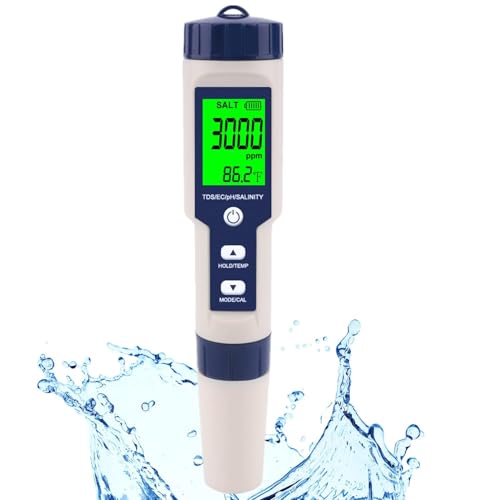
- Combines salinity, TDS, EC, pH, and temperature
- Supports seawater readings from 10–200 ppt
- Displays ppm, ppt, and percent
Best For: Aquarium and marine users needing broader water testing
Best Analog Pick
hygger Acrylic Aquarium Hydrometer

- Battery-free analog salinity and specific-gravity testing
- Temperature-corrected accuracy of +/-0.001
- Wide base and clear acrylic construction
Best For: Brackish and reef aquarium keepers wanting simple routine testing
Best Digital Salinity Pen

- Measures specific gravity, salinity, and temperature
- Backlit display with automatic temperature compensation
- Portable waterproof pen design with auto shutoff
Best For: Marine aquarists wanting quick, portable digital checks
Best Manual Refractometer – Agriculture Solutions Salinity Refractometer
For aquarium keepers seeking salinity meters for aquariums, this manual refractometer provides readings on both specific gravity and parts-per-thousand scales. Its automatic temperature compensation is useful for routine marine-water checks.
Best For: Marine fishkeeping and aquarium owners who prefer a portable optical tester with dual scales.
Pros:
- Measures specific gravity and parts per thousand.
- Automatic temperature compensation helps simplify testing.
- Includes a hard case, dropper, screwdriver, manual, and cleaning cloth.
Cons:
- Requires manual viewing through the refractometer rather than a digital display.
- Needs a small water sample and cleaning after use.
This is a practical, durable-feeling option for users who want straightforward salinity testing with useful accessories and two measurement scales.
Best Digital Option – Milwaukee MA887 Salinity Refractometer
The Milwaukee MA887 is a strong choice among salinity meters for aquariums when you want digital readings and quick operation. It measures seawater salinity in three commonly used units and provides results in about 1.5 seconds.
Best For: Saltwater aquarium and reef-tank owners who want fast, digitally displayed readings.
Pros:
- Displays PSU, parts per thousand, and specific gravity.
- Automatic temperature compensation supports consistent readings.
- Sealed glass prism and stainless-steel well are easy to clean.
Cons:
- Heavier and larger than a basic manual refractometer.
- Includes a pipette and manual, but fewer listed accessories than some optical kits.
With multiple units, rapid response, and a wipe-clean sample area, the MA887 is suited to aquarists who prioritize convenience and repeatable digital measurements.
Best Budget Hydrometer – Coralife Deep Six Hydrometer
The Coralife Deep Six is a simple hydrometer for aquarists who want accessible salinity meters for aquariums without an optical or digital instrument. Its clear scale and bubble-resistant design are intended to make specific-gravity readings easy to follow.
Best For: Aquarium owners seeking a straightforward specific-gravity hydrometer for warm-water tanks.
Pros:
- Easy-to-read scale with clear markings.
- Rated accurate to ±0.001 specific-gravity units.
- Calibrated for aquariums from 68–85°F (20–30°C).
Cons:
- Measures specific gravity rather than offering multiple salinity units.
- Its calibration range is focused on warm aquarium water.
This is a no-frills choice for routine aquarium checks, especially when a readable, bubble-resistant hydrometer meets your testing needs.
Best Portable Value – Aquarium Seawater Salinity Refractometer
This portable refractometer is a practical pick among salinity meters for aquariums, measuring both specific gravity and parts per thousand from a two- to three-drop sample. Automatic temperature compensation is built in for faster, easier readings.
Best For: Fishkeepers who want a compact manual tester for aquariums, marine monitoring, or saltwater pools.
Pros:
- Provides specific-gravity and ppt readings from one test.
- Automatic temperature compensation supports convenient testing.
- Aluminum and ABS construction, case, dropper, screwdriver, and cloth are included.
Cons:
- Readings must be viewed through the optical eyepiece.
- Requires manual sample placement and cleaning.
Its broad stated use, compact format, and included kit make it a flexible option for users who want dual-scale salinity testing without a digital instrument.
Best for Saltwater Pools and Koi Ponds – SALT-3050 Digital Salinity Meter
Among salinity meters for aquariums, the SALT-3050 is a specialized option for saltwater pools and koi ponds rather than marine fish tanks. It measures salt concentration from 0–9,999 ppm or 0.0–1.0% and also displays temperature.
Best For: Saltwater pool and koi pond owners who want a compact, waterproof salt tester.
Pros:
- Measures 0–9,999 ppm or 0.0–1.0% salt concentration
- Includes temperature readings from 0–55°C (32–130°F)
- IP65 waterproof-rated design
- Precalibrated at 3,000 ppm NaCl and 25°C (77°F)
Cons:
- Not designed for sea, marine, or saltwater fish tanks
- Not suitable for food salt testing or other applications
The focused design makes this a practical pool or koi-pond tool, but its stated limitations are especially important for aquarium shoppers: it is not intended for marine aquariums.
Best Refractometer for Marine Aquariums – Seawater Salinity Refractometer
For shoppers comparing salinity meters for aquariums, this seawater refractometer provides a straightforward optical way to check marine water. Add 2–3 drops to the prism, then read salinity or specific gravity through the eyepiece.
Best For: Marine aquarium and seawater users who prefer a compact refractometer with automatic temperature compensation.
Pros:
- Designed for seawater and marine aquarium monitoring
- Measures 0–100 ppt salinity
- Reads specific gravity from 1.000–1.070 g/cm³
- ATC operates from 10–30°C
Cons:
- Requires placing a liquid sample on the prism
- Does not provide electronic temperature, pH, EC, or TDS readings
This is a focused seawater tester rather than a multiparameter meter. Its drop-sample operation and marine-oriented range make it a sensible fit for aquarium keepers monitoring saltwater concentration.
Best Multiparameter Option – Hofun 5-in-1 Salinity and pH Meter
If you want salinity meters for aquariums that also cover broader water checks, the Hofun combines salinity, TDS, EC, pH, and temperature functions. Its salinity modes display results in ppm, ppt, or percent across pool and seawater ranges.
Best For: Aquarium, marine, pool, spa, and hydroponic users who want several water measurements in one handheld meter.
Pros:
- Combines salinity, TDS, EC, pH, and temperature testing
- Displays salinity in ppm, ppt, and percent
- Supports seawater testing from 10–200 ppt
- Titanium alloy probe is designed for quick measurement
Cons:
- Its many functions may be more than needed for simple salinity testing
- Salt ranges vary by application, including pool, seawater, and food modes
The Hofun is the most versatile choice of these three products for users who also need pH and other water-quality readings. It offers broad coverage, though buyers seeking only marine salinity may prefer a dedicated refractometer.
Best Analog Pick – hygger Acrylic Aquarium Hydrometer
For shoppers comparing salinity meters for aquariums, the hygger hydrometer offers a straightforward, battery-free way to check salinity and specific gravity. Fill it with tank water, place it on a level surface, and read the swing-arm scale.
Best For: Brackish and reef aquarium keepers who prefer a simple analog tester.
Pros:
- Measures salinity and specific gravity for marine aquariums.
- Temperature-corrected accuracy is specified at +/-0.001.
- Wide base and clear acrylic body support easy reading and handling.
Cons:
- Requires filling, placing, and manually reading the unit.
- Its specific-gravity range is limited to 1.000–1.030.
- Needs vinegar soaking, rinsing, and air drying after use.
This is a practical choice when you want uncomplicated routine checks without batteries or calibration buffers. Its included salinity and specific-gravity scales make it useful for common brackish and marine aquarium maintenance.
Best Multi-Parameter Meter – YINMIK YK-5 5-in-1 Tester
If you want salinity meters for aquariums that also monitor broader water conditions, the YINMIK YK-5 combines pH, TDS, EC, salinity, and temperature testing in one digital device. Its wide salt range covers both saltwater aquarium and seawater applications.
Best For: Aquarists who want one tester for salinity plus pH, conductivity, TDS, and temperature.
Pros:
- Combines five water-quality measurements in one meter.
- Measures seawater salinity from 0.00 to 200.0 ppt.
- Includes six calibration buffer bags and has a replaceable probe.
- Also supports pool, spa, koi pond, RO/DI, and hydroponic testing.
Cons:
- Requires calibration and uses three included LR44 batteries.
- Its broad feature set may be more than needed for salinity-only checks.
- Readings depend on maintaining the probe and calibration supplies.
The YK-5 is the most versatile option of this group for aquarium owners who routinely track several water parameters. A replaceable probe can also help extend its useful life compared with a tester that must be replaced as a complete unit.
Best Digital Salinity Pen – 3-in-1 Saltwater Tester
Among salinity meters for aquariums, this digital pen emphasizes quick readings and portability. It measures specific gravity, salinity, and temperature, while automatic temperature compensation and a backlit display make routine checks easier to read.
Best For: Marine aquarium owners who want a portable digital meter focused on salinity-related readings.
Pros:
- Measures specific gravity, salinity, and temperature in one device.
- Backlit LCD, automatic temperature compensation, and audible testing alerts simplify use.
- Offers salinity readings from 0 to 55 ppt and specific gravity from 1.000 to 1.045.
- Automatically powers off after 60 seconds and includes a low-battery indicator.
Cons:
- Specified accuracy is +/-0.002 for specific gravity and +/-1 ppt for salinity.
- Requires two AAA batteries.
- It does not provide the additional pH, EC, or TDS measurements offered by a multiparameter meter.
This pen-style tester is a convenient fit when speed, visibility, and portability matter more than measuring a wide range of water chemistry values. Its temperature and salinity readings cover common aquarium monitoring needs in a compact format.
How We Picked the Best Salinity Meters for Aquariums
We focused on measurement range, ease of calibration, readability, temperature compensation, construction, and the type of aquarium each tester suits. The selection includes optical refractometers, digital refractometers, electronic meters, and traditional hydrometers so beginners and experienced marine keepers can compare the right testing method.
We also considered whether a device reports specific gravity, parts per thousand (ppt), practical salinity, temperature, pH, EC, or TDS. Extra readings can be useful, but they should not distract from accurate salinity measurement.
Quick Comparison
| Tester type | Best for | Main advantage | Potential drawback |
|---|---|---|---|
| Optical refractometer | Marine and reef aquariums | Clear readings with no batteries | Requires calibration and a sample |
| Digital refractometer | Fast, repeatable testing | Simple digital display and small sample size | Costs more and needs battery power |
| Electronic salinity meter | Frequent testing and multiple parameters | Quick readings with added temperature or water-quality data | Probes require cleaning and calibration |
| Hydrometer | Budget-conscious beginners | Inexpensive and straightforward | More sensitive to bubbles, level, and temperature |
Key Buying Factors for Salinity Meters for Aquariums
Measurement Format and Range
Choose a meter that matches the numbers used for your aquarium. Marine systems commonly use specific gravity or ppt, while some products display both. A range around 0–100 ppt and specific gravity near 1.000–1.070 covers most saltwater aquarium needs.
Accuracy and Calibration
Calibration is as important as the instrument itself. Look for simple zero calibration, suitable calibration fluid, and clear instructions. Recheck a meter periodically, especially after storage, battery changes, or heavy use.
Temperature Compensation
Water temperature affects salinity readings. Automatic temperature compensation can make testing more consistent, particularly with refractometers. It does not eliminate the need to use the device within its stated temperature range.
Maintenance and Durability
Rinse samples and probes with fresh, purified water after every test, then dry them as directed. Waterproof or splash-resistant construction is useful around sumps and mixing stations, but never assume a meter can be submerged unless its specifications say so.
Who Should Buy Which Salinity Meters for Aquariums?
Choose a refractometer if you want dependable, easy-to-read testing for a reef or marine aquarium. A digital refractometer is a strong choice for frequent testing or users who prefer a guided digital display. Select an electronic multifunction meter if you also need temperature, pH, EC, or TDS readings and are willing to maintain the probe.
A hydrometer works well as an affordable starting point or backup, especially for basic fish-only systems. However, careful filling, bubble removal, level positioning, and temperature awareness are essential for trustworthy results. Whichever style you choose, compare readings against your aquarium’s target range and make salinity changes gradually.