Choosing among portable water quality meters can be difficult when product listings combine TDS, EC, pH, turbidity, temperature, and multi-function testing in different ways.
This roundup compares 10 portable options for drinking water checks, aquarium care, wells, pools, fieldwork, and routine home monitoring, with attention to measurement range, accuracy, usability, and value.
Best 10 Portable Water Quality Meters Picks for 2026
Field-Ready Precision
Sper Scientific Turbidity Meter

- ISO 7027 nephelometric turbidity testing
- Large LCD with auto calibration and recall
- Carry case and calibration supplies included
Best For: Dedicated turbidity testing in field and laboratory settings
Connected Everyday Testing

- Measures TDS, EC, TOC, COD, UV275, and temperature
- App records readings and tracks trends
- Color-coded results for quick interpretation
Best For: Portable household and travel water screening with data tracking
Hydrogen and pH Specialist

- Measures hydrogen, ORP, pH, EC, TDS, salt, and temperature
- Fixed pH and temperature display
- Includes calibration kit and automatic temperature compensation
Best For: Hydrogen-water, hydroponic, pool, and beverage testing
Broad-Spectrum Travel Testing
Landtek 9-in-1 Water Quality Meter

- Measures nine parameters including COD, TOC, EC, and salinity
- Color-coded four-level water-quality display
- Compact design with two AAA batteries included
Best For: Broad household, travel, aquaculture, and seawater screening
Best Budget Pick

- 0-9990 ppm measurement range
- Hold function and large LCD
- Approx. 1000-hour battery usage
Best For: Basic, affordable TDS testing
Best Multifunction Value
Digital TDS, EC & Temperature Meter
- Measures TDS, EC, and temperature
- Backlit LCD with auto-lock
- Includes portable leather bag
Best For: Multipurpose water testing at home or on the go
Best Feature-Rich Pick
DANOPLUS 6-in-1 Water Quality Tester

- Measures six water-quality indicators
- Color-coded four-level rating display
- Compact design with 2 AAA batteries
Best For: Broad home, travel, and preparedness testing
Best All-Around Value
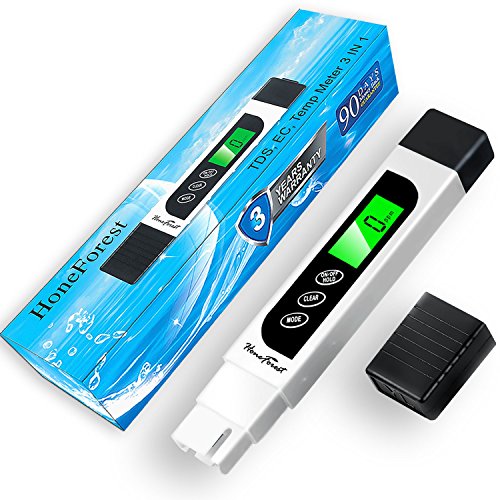
3-in-1 TDS, EC & Temperature Tester

- Measures TDS, EC, and temperature
- Backlit display with auto-lock
- 3-year warranty and 90-day guarantee
Best For: Routine household, aquarium, and hydroponic checks
Most Comprehensive Testing
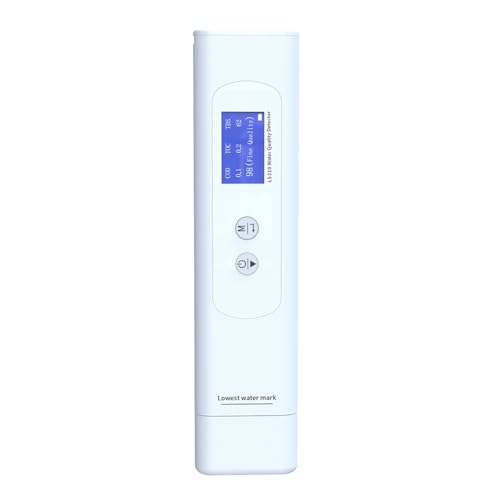
- Measures six water-quality indicators
- Color-coded quality assessment LEDs
- Includes batteries and powder-free calibration
Best For: Broad household, outdoor, and water-system testing
Best for Easy Reading
4-in-1 TDS, EC & Temperature Meter

- Large backlit display for easier viewing
- Reads TDS, EC, and °C/°F temperature
- Includes hold, auto-lock, and auto-off features
Best For: Simple home, filter, aquarium, and hydroponic monitoring
Field-Ready Precision – Sper Scientific Turbidity Meter
For buyers seeking portable water quality meters focused on turbidity, the Sper Scientific 860040 is designed for accurate field and lab measurements. It uses the ISO 7027 nephelometric method, offers automatic two-point calibration, and includes supplies for getting started.
Best For: Water treatment, environmental, industrial, beverage, pharmaceutical, and laboratory turbidity testing.
Pros:
- Measures turbidity using an ISO 7027-compliant nephelometric method.
- Large LCD, autoranging, and minimum/maximum recall simplify readings.
- Includes 0 NTU and 100 NTU calibration solutions, sample bottles, distilled water, and a carry case.
- Long-lasting light source and reliable circuitry support repeated use.
Cons:
- Measures turbidity rather than multiple water-quality parameters.
- At 4 pounds, it is less lightweight than pen-style testers.
- Requires six AAA batteries.
This is the strongest choice when turbidity accuracy and a complete testing kit matter more than minimal size or multiparameter monitoring.
Connected Everyday Testing – Kactoily 6-in-1 Water Tester
This Kactoily tester expands beyond basic TDS readings by combining six measurements—TDS, EC, TOC, COD, UV275, and temperature—in a compact portable water quality meter. Its app can record results and help compare water sources or filtration performance over time.
Best For: Home users monitoring tap, well, RV, camping, lake, or pond water and tracking changes through an app.
Pros:
- Combines six parameters for a broader view of dissolved and organic contamination indicators.
- App connectivity supports real-time viewing and manual data recording.
- Color-coded results provide quick Excellent, Good, Medium, or Poor guidance.
- Compact pen-style design and one-button calibration are convenient for travel.
Cons:
- Calibration requires purified or distilled water.
- Its readings are intended for assessment and tracking rather than replacing professional laboratory analysis.
- The supplied notes do not specify battery details or an included carry case.
Choose this model if app-based records and multiparameter screening are more useful to you than a single-purpose turbidity instrument.
Hydrogen and pH Specialist – 7-in-1 Digital Water Tester
Among portable water quality meters, this 7-in-1 tester stands out for hydrogen and ORP measurement alongside pH, EC, TDS, salt, and temperature. The fixed pH and temperature display keeps key readings visible while the other values rotate on screen.
Best For: Hydrogen-water users, hydroponic growers, saltwater pool owners, and people testing beverages such as kombucha or wine.
Pros:
- Measures dissolved hydrogen from 0–2400 ppb and ORP up to ±999 mV.
- Displays pH and temperature continuously for easier monitoring.
- Automatic temperature compensation supports testing across changing water temperatures.
- Includes a full calibration kit and arrives factory pre-calibrated.
Cons:
- Its specialized hydrogen and ORP functions may be unnecessary for basic drinking-water checks.
- Only pH and temperature remain fixed while other measurements rotate.
- The supplied notes do not provide battery specifications.
This is a versatile, specialty-focused option for users who need hydrogen and ORP data in addition to standard pH and dissolved-solids measurements.
Broad-Spectrum Travel Testing – Landtek 9-in-1 Water Quality Meter
The Landtek 9-in-1 is a compact portable water quality meter for users who want several screening measurements in one device. It covers COD, TOC, UV275, TDS, EC, salinity, hardness, specific gravity, and temperature, with color-coded scoring for quick interpretation.
Best For: Household, travel, aquaculture, seawater, tap-water, well-water, and water-purifier checks.
Pros:
- Offers nine water-quality parameters in a single compact tester.
- Four-color backlighting makes results easy to interpret at a glance.
- Built-in temperature compensation supports a stated 0–50°C working range.
- Uses quick one-button calibration with distilled or pure water and includes two AAA batteries.
Cons:
- Color ratings simplify results and may not provide the detail of dedicated laboratory instruments.
- Calibration should be performed weekly for experimental use.
- The supplied notes specify testing for non-sewage surface water, not sewage.
For broad everyday screening in a small package, this Landtek model offers more measurement categories than a basic TDS meter while keeping operation simple.
Best Budget Pick – HM Digital TDS-EZ
The HM Digital TDS-EZ is a straightforward choice for shoppers who want one of the more affordable portable water quality meters for checking dissolved solids. Its simple design, broad 0-9990 ppm range, and large LCD make it practical for routine household testing.
Best For: Budget-conscious users who need basic TDS measurements for everyday water checks.
Pros:
- Measures from 0 to 9990 ppm, with 1 ppm resolution through 999 ppm.
- Hold function saves readings for easier recording.
- Large LCD, automatic shutoff, and approximately 1000 hours of battery usage.
- Can be recalibrated with a mini-screwdriver.
Cons:
- Measures TDS rather than offering EC or temperature readings.
- Higher readings use 10 ppm increments, indicated by a blinking x10 display.
- Uses small LR44-type button-cell batteries.
This is a sensible entry-level meter when you primarily need quick TDS readings and do not require a multifunction tester. The included TDS chart sticker and hold feature add convenience for routine use.
Best Multifunction Value – Digital TDS, EC & Temperature Meter
This digital tester expands beyond basic TDS readings by combining TDS, electrical conductivity, and temperature measurements. Among portable water quality meters, it is a useful option for checking drinking water, RO/DI systems, aquariums, hydroponics, pools, and spas.
Best For: Users who want TDS, EC, and temperature readings in one compact meter.
Pros:
- Three-in-one testing for TDS, EC, and temperature in Fahrenheit or Celsius.
- Titanium alloy probe and intelligent chip are designed for stable, accurate performance.
- Large backlit LCD and automatic reading lock make results easier to view.
- Includes a portable leather bag for storage and transport.
Cons:
- Automatic shutoff activates after more than two minutes without operation.
- The supplied notes do not specify the meter’s calibration method or battery life.
Choose this model if temperature and EC data matter alongside TDS. Its auto-lock display and backlight also make it more convenient for quick checks in varied settings.
Best Feature-Rich Pick – DANOPLUS 6-in-1 Water Quality Tester
The DANOPLUS 6-in-1 is designed for shoppers seeking more than a basic TDS check. It combines TOC, COD, EC, UV275, temperature, and TDS functions with a color-coded water-quality rating, making it one of the more feature-rich portable water quality meters for home and outdoor use.
Best For: Home, RV, camping, travel, well-water, and emergency-preparedness testing where multiple indicators are useful.
Pros:
- Provides TOC, COD, EC, UV275, temperature, and TDS readings.
- Color backlight rates results as fine, good, average, or poor.
- Compact 6.18-inch design and included 2 AAA batteries support portability.
- Calibration can be completed with distilled or pure water without calibration powder.
Cons:
- More functions may be unnecessary for users who only need basic TDS readings.
- Calibration guidance recommends weekly calibration for experiments.
- It should not be calibrated with mineral or natural drinking water.
This tester stands out when broad water-quality information and quick visual interpretation are priorities. For regular home or travel use, the rating display simplifies results, while experimental users should follow the stated calibration schedule.
Best All-Around Value – 3-in-1 TDS, EC & Temperature Tester
For everyday portable water quality meters use, this 3-in-1 tester combines TDS, electrical conductivity, and temperature readings in a compact pen-style design. Its backlit display and auto-lock function make quick checks easier in dim lighting or while handling samples.
Best For: Drinking water, filtered water, RO systems, aquariums, and hydroponics.
Pros:
- Measures TDS, EC, and water temperature in one reading.
- Titanium alloy probe is designed for stable, accurate performance, with stated readout accuracy of +/- 3%.
- Backlit LCD and auto-lock function improve readability and convenience.
- Includes a 3-year warranty and 90-day money-back guarantee.
Cons:
- It does not provide the broader six-indicator testing offered by some more advanced meters.
- The supplied notes do not specify included batteries or a calibration procedure.
This is a practical choice when you want straightforward readings for household water and hobby applications without paying for a more specialized testing platform.
Most Comprehensive Testing – 6-in-1 Water Quality Meter
This portable water quality meter is designed for buyers who want more than basic TDS readings. It measures COD, TOC, UV275, TDS, EC, and temperature, while its color-coded quality assessment system provides a quick visual indication of the measured water rating.
Best For: Users testing drinking, tap, well, pool, aquarium, hydroponic, wastewater, or RO/DI water.
Pros:
- Offers six measurements, including COD, TOC, UV275, TDS, EC, and temperature.
- Color-coded LEDs classify results as excellent, fair, moderate, or low.
- Compact pen-like design includes two AAA batteries.
- Calibration uses distilled or purified water without requiring calibration powder.
Cons:
- Its larger set of readings may be more than casual users need.
- Calibration requires distilled or purified water and should not use mineral or natural drinking water.
Choose this model if breadth of measurement and on-the-spot water assessment matter more than having the simplest possible TDS-only workflow.
Best for Easy Reading – 4-in-1 TDS, EC & Temperature Meter
Among portable water quality meters, this 4-in-1 option emphasizes readable results and simple operation. It measures TDS, EC, and temperature in Celsius or Fahrenheit, with a larger backlit screen, hold function, auto-lock, and two-minute automatic shutoff.
Best For: Homeowners, families, aquarium and hydroponic users, and anyone monitoring RO/DI or filter performance.
Pros:
- Measures TDS, EC, and temperature with Celsius/Fahrenheit support.
- 25% larger backlit LCD is intended to make readings easier to see.
- Factory calibration, hold function, auto-lock, and two-minute auto-off support convenient use.
- Built-in TDS chart helps users interpret PPM values more quickly.
Cons:
- It does not measure the additional COD, TOC, or UV275 indicators found on six-in-one meters.
- The supplied notes do not state the battery type or include a warranty period.
This is a strong fit for routine water checks when display readability, simple controls, and temperature-unit flexibility are high priorities.
How We Picked These Portable Water Quality Meters
We focused on portable testers that cover common water-checking needs while offering clear specifications, practical measurement ranges, and straightforward operation. The selection includes simple TDS meters, multi-function digital testers, app-connected devices, and a dedicated turbidity meter for users who need more specialized information.
We also considered display readability, portability, stated accuracy, resolution, temperature support, calibration requirements, and the types of water each tester is intended to evaluate. Because product capabilities vary widely, buyers should treat these devices as screening and monitoring tools rather than replacements for certified laboratory analysis.
Quick Comparison
| Tester Type | Best For | Typical Measurements |
|---|---|---|
| Basic TDS meter | Routine household checks | TDS, sometimes temperature |
| Multi-function tester | Broader water monitoring | TDS, EC, temperature, and sometimes COD, TOC, or UV275 |
| pH/ORP meter | Aquariums, pools, and process water | pH, ORP, temperature, and related readings |
| Turbidity meter | Cloudiness and suspended particles | Turbidity |
| App-connected tester | Digital logging and guidance | Multiple readings with smartphone support |
Key Buying Factors for Portable Water Quality Meters
Choose the Measurements You Actually Need
TDS indicates dissolved solids but does not identify specific contaminants or prove that water is safe to drink. EC measures conductivity, while pH and ORP are useful for different applications. Turbidity measures cloudiness and should not be confused with TDS. If you need a broad screening profile, a multi-function model may be more useful than a basic TDS-only device.
Check Range, Accuracy, and Resolution
A wide range is helpful for wells, hydroponics, pools, and other variable sources, but accuracy and repeatability matter just as much. Look for stated readout accuracy, resolution, automatic temperature compensation, and a calibration process you can follow. Replaceable or calibratable probes can improve long-term usefulness.
Consider Handling and Maintenance
A portable tester should be easy to hold, rinse, read, and store. Waterproof construction, an automatic shutoff, a backlit display, and a protective cap can make regular testing easier. Sensors should be rinsed after use and stored according to the manufacturer’s instructions; some probes require special storage solution.
Who Should Buy Which Portable Water Quality Meters?
For occasional household checks: Choose a straightforward TDS meter with a clear display and dependable basic accuracy.
For broader home and field screening: A 6-in-1 or 9-in-1 tester can provide more context across drinking water, tap water, wells, pools, and other sources, provided you understand what each measurement represents.
For aquariums, pools, and technical applications: Prioritize pH, ORP, temperature, calibration controls, and probe quality over a high measurement count.
For sediment or clarity concerns: Select a dedicated turbidity meter, since TDS readings cannot measure suspended particles reliably.
For record keeping: An app-connected model may be worthwhile if you regularly compare readings, monitor changes, or need a digital testing history.