The right infrared thermometer makes it easier to check pan surfaces, pizza stones, griddles, grills, and other cooking equipment without making contact. These 10 picks cover a range of temperature limits, display designs, targeting features, and probe options.
Whether you need a simple surface-temperature reader or a more versatile tool for cooking and home repairs, this roundup highlights the features that matter most for reliable kitchen use.
Best 10 Infrared Thermometers for Home Kitchens Picks for 2026
Best All-Purpose Pick

- -58°F to 842°F range
- 12:1 distance-to-spot ratio
- Backlit display and included batteries
Best For: Versatile kitchen and household surface checks
Best High-Heat Range
- -58°F to 1,022°F range
- Adjustable emissivity from 0.1 to 1.0
- MAX/MIN/AVG scan readings
Best For: Pizza ovens, griddles, and varied surfaces
Best Simple Professional-Style Pick
- -4°F to 752°F measurement range
- 10:1 optical resolution
- Laser, backlight, pouch, and battery included
Best For: Simple routine surface measurements
Best 2-in-1 Cooking Tool

- Infrared sensor plus meat probe
- Surface range up to 1,022°F
- Motion-sensing wake/sleep design
Best For: Surface, internal food, candy, and liquid temperatures
Best High-Range Option

- -58°F to 1130°F range
- 12:1 distance-to-spot ratio
- Adjustable 0.1–1.0 emissivity
Best For: High-heat cooking and versatile surface checks
Best Everyday Value
KNINE OUTDOORS Infrared Thermometer

- -58°F to 1112°F range
- Single-laser targeting
- 0.1°F/°C resolution
Best For: Routine cooking and candy-making temperature checks
Best Simple Cooking Pick

- -58°F to 932°F range
- Backlit LCD with data hold
- Preset 0.95 emissivity
Best For: BBQ, pizza ovens, and basic surface checks
Best Overall
Etekcity Lasergrip Color Display

- -58°F to 1130°F range
- Color LCD with max-temperature display
- Adjustable emissivity and fast readings
Best For: Home cooks wanting a versatile, easy-to-read surface thermometer
Best for Calibration
UW510 Adjustable Emissivity Thermometer

- One-button calibration function
- -58°F to 1112°F temperature range
- Backlit LCD with auto-shutoff
Best For: Users who prioritize calibration and readable kitchen surface checks
Most Feature-Rich
IR02C-OR Dual-Mode Thermometer

- Infrared and K-type probe measurements
- -58°F to 1472°F range
- Color display and two alarm modes
Best For: Users wanting surface scanning plus contact-probe capability
Best All-Purpose Pick – Etekcity Lasergrip 774
If you want infrared thermometers for home kitchens that can also handle household projects, the Etekcity Lasergrip 774 offers fast, non-contact surface readings across a broad temperature range. Its backlit display, included batteries, and 12:1 distance-to-spot ratio make it practical for checking cookware and other surfaces from a short distance.
Best For: Home cooks who want a versatile infrared thermometer for kitchen and general household use.
Pros:
- Measures from -58°F to 842°F with readings in under half a second.
- 12:1 distance-to-spot ratio supports comfortable, non-contact measuring.
- Backlit LCD, auto-off, and two included AAA batteries improve convenience.
- Displays an average temperature for the targeted surface area.
Cons:
- Designed for surface temperatures rather than internal food temperatures.
- Its fixed listed features may offer less surface customization than models with adjustable emissivity.
The Lasergrip 774 is a strong general-purpose choice when you want a simple, quick surface scanner for cookware, grills, ovens, and tasks beyond the kitchen.
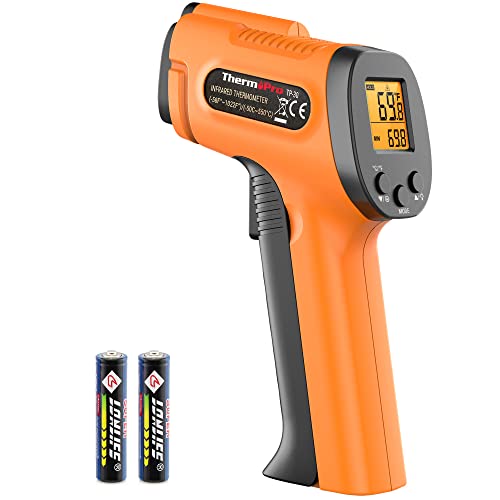
Best High-Heat Range – TempPro TempScan CORE
For infrared thermometers for home kitchens that need to cover very hot cooking surfaces, the TempPro TempScan CORE stands out with a range up to 1,022°F. Adjustable emissivity helps it account for different surface materials, while the quick response and MAX/MIN/AVG readouts add useful context during cooking or home maintenance.
Best For: Pizza ovens, griddles, and users who want adjustable readings for varied surfaces.
Pros:
- Measures from -58°F to 1,022°F.
- Adjustable emissivity from 0.1 to 1.0 helps match the measured surface.
- 12:1 distance-to-spot ratio and response time under 500 milliseconds.
- Displays maximum, minimum, and average temperatures from the last scan.
Cons:
- It is a surface thermometer and does not replace a probe for internal food temperatures.
- The supplied notes list a plastic exterior and do not specify a protective case.
Its unusually high upper range and adjustable emissivity make the TempScan CORE particularly useful for high-heat cooking setups, especially pizza ovens and griddles.
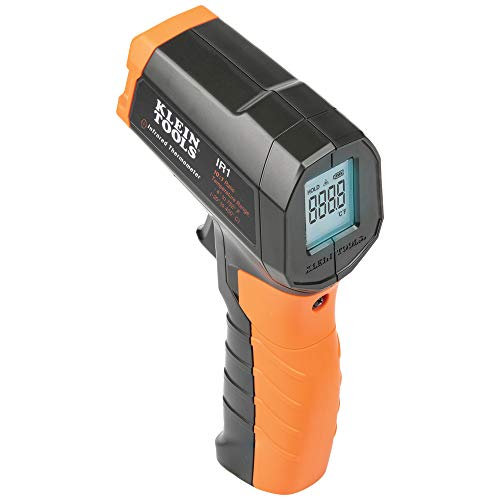
Best Simple Professional-Style Pick – Klein Tools IR1
The Klein Tools IR1 is a straightforward option among infrared thermometers for home kitchens, with a targeting laser, backlit display, and auto power-off. Its 10:1 optical resolution is suited to measuring surfaces from a distance, while the fixed 0.95 emissivity keeps operation simple.
Best For: Users who prefer a simple, durable-feeling infrared thermometer for routine surface measurements.
Pros:
- Measures temperatures from -4°F to 752°F.
- 10:1 distance-to-spot ratio supports readings from a distance.
- Targeting laser and backlit display make aiming and reading easier.
- Includes a custom pouch and one 9V battery.
Cons:
- Its 752°F maximum is lower than some competing options in this roundup.
- Fixed emissivity of 0.95 offers less adjustment for different surfaces.
- It is explicitly non-medical and not intended for people or animals.
The IR1 is a sensible pick when you value uncomplicated controls and basic targeting features over an especially broad temperature range or adjustable emissivity.
Best 2-in-1 Cooking Tool – TempPro TempScan PLUS
The TempPro TempScan PLUS is one of the most versatile infrared thermometers for home kitchens because it combines non-contact surface scanning with a meat probe. Use the infrared sensor for pans, griddles, pizza stones, and oven walls, then switch to the probe for internal food, candy, frying oil, or liquid temperatures.
Best For: Home cooks who need one thermometer for both surface temperatures and internal food readings.
Pros:
- Combines a 12:1 infrared sensor with a built-in meat probe.
- Infrared range reaches up to 1,022°F with adjustable emissivity.
- Probe provides internal readings with stated ±1.8°F precision in 2–3 seconds.
- Motion-sensing wake/sleep, auto-off, magnet, and hanging hole add convenience.
Cons:
- Combines more functions than a basic infrared-only thermometer, which may be unnecessary for simple surface checks.
- The supplied notes do not state the probe’s maximum temperature range.
For kitchen versatility, the TempScan PLUS is the most complete option here: it can check whether a cooking surface is ready and whether the food itself has reached the desired temperature.
Best High-Range Option – Etekcity Lasergrip 1080
For home cooks who want especially broad coverage, the Etekcity Lasergrip 1080 is one of the more versatile infrared thermometers for home kitchens. It reads from -58°F to 1130°F, offers adjustable emissivity, and displays the maximum measured surface temperature.
Best For: High-heat cooking, heat-gun checks, ovens, grills, and users who want adjustable settings.
Pros:
- Very wide -58°F to 1130°F measurement range
- 12:1 distance-to-spot ratio supports safer remote readings
- Adjustable emissivity from 0.1 to 1.0
- Backlit display, fast 0.5-second response, and auto-off
Cons:
- Designed for surface temperatures rather than internal food temperatures
- Best results require positioning about 14.17 inches from the target
Its broad range and customization make it a strong choice for demanding kitchen tasks, though beginners may not need all of its settings.
Best Everyday Value – KNINE OUTDOORS Infrared Thermometer
The KNINE OUTDOORS thermometer is a straightforward pick for home cooks who need broad temperature coverage without contact. Among infrared thermometers for home kitchens, it stands out with a -58°F to 1112°F range, single-laser targeting, and a readable eye-protect LCD.
Best For: Cooking, candy making, oven checks, pool maintenance, and general non-contact temperature readings.
Pros:
- Measures from -58°F to 1112°F
- 12:1 distance-to-spot ratio enables readings from a safer distance
- Adjustable emissivity from 0.1 to 1.0
- 0.1°F/°C resolution with selectable units
Cons:
- Uses a single laser rather than multiple targeting lasers
- Supplied details do not specify a response time
This is a practical, flexible option for routine kitchen measurements, especially if you value a large display and simple controls.
Best Simple Cooking Pick – GM50 Backlit IR Thermometer
The GM50 is a simple handheld choice for cooks checking grills, pizza ovens, and other surfaces. It measures from -58°F to 932°F and adds a backlit LCD, data hold, and automatic shutoff, making it a convenient entry-level option among infrared thermometers for home kitchens.
Best For: BBQ, pizza ovens, nighttime or low-light readings, and basic surface-temperature checks.
Pros:
- Wide -58°F to 932°F measurement range
- Backlit LCD is useful in low light
- 0.1°F/°C display resolution with unit conversion
- Data hold and approximately eight-second auto-off
Cons:
- Preset emissivity of 0.95 is not adjustable
- Shiny or polished metal surfaces can produce inaccurate readings
- Not intended for measuring human body temperature
Its uncomplicated controls suit everyday cooking, but users measuring reflective cookware should follow the supplied masking-tape or flat-black-paint workaround.
Best Overall – Etekcity Lasergrip Color Display
For shoppers comparing infrared thermometers for home kitchens, the Etekcity Lasergrip 1260 is a versatile choice with a clear color display, fast readings, and adjustable emissivity. It measures surface temperatures from -58°F to 1130°F, making it suitable for checking grills, griddles, ovens, and other household equipment.
Best For: Home cooks who want a broadly useful infrared thermometer with an easy-to-read color screen.
Pros:
- Measures from -58°F to 1130°F with stated accuracy of ±2%.
- Color LCD displays readings and maximum temperatures clearly.
- Adjustable emissivity from 0.1 to 1.0 supports different surfaces.
- Fast readings arrive in less than 0.5 seconds, with a 15-second display hold.
Cons:
- It is non-contact, so it measures surface temperature rather than internal food temperature.
- The unit is battery powered and requires two AAA batteries.
- The thermometer is not washable, so it should be kept away from spills.
Its wide temperature range, included batteries, and two-year warranty make it a practical all-purpose option. Use it for surface checks, while relying on a probe thermometer when internal food temperature is the goal.
Best for Calibration – UW510 Adjustable Emissivity Thermometer
The UW510 stands out among infrared thermometers for home kitchens with a one-button calibration function designed to help maintain consistent readings over time. Its -58°F to 1112°F range, backlit LCD, and 0.5-second response suit tasks such as checking food surfaces, cooking oils, ovens, and household appliances.
Best For: Cooks who value calibration controls and a straightforward backlit display.
Pros:
- One-button CAL function is designed to counter measurement drift.
- Wide -58°F to 1112°F measurement range covers kitchen and household uses.
- Backlit LCD improves visibility in low-light conditions.
- Auto-shutoff and low-battery indication help manage battery use.
Cons:
- It measures surface temperature and does not replace an internal food thermometer.
- The supplied details do not specify a warranty or distance-to-spot ratio.
- It requires two AAA batteries, even though they are included.
This is a sensible pick when repeatable surface checks and calibration are priorities. Its yellow housing and simple controls also make it easy to identify and use around a busy kitchen.
Most Feature-Rich – IR02C-OR Dual-Mode Thermometer
For buyers seeking feature-rich infrared thermometers for home kitchens, the IR02C-OR combines non-contact infrared measurement with a K-type probe. It reaches temperatures up to 1472°F and adds adjustable emissivity, humidity and dew-point information, color-screen visibility, and alarm modes for broader kitchen and home-maintenance use.
Best For: Users who want both surface scanning and contact-probe capability in one kit.
Pros:
- Offers infrared surface measurement plus K-type probe contact measurement.
- Wide -58°F to 1472°F range with a stated accuracy of up to ±1.5%.
- Includes spoilage and temperature-difference alarm modes.
- Package includes a probe, carry bag, batteries, screwdriver, and manual.
Cons:
- The product is more complex than a basic surface-only thermometer.
- Infrared readings are intended for inanimate objects; human and animal readings may be inaccurate.
- It requires batteries and has a listed battery life of eight hours.
The IR02C-OR is the most versatile option here for shoppers who want extra measurement functions and accessories. The included K-type probe is especially useful when a surface reading alone is not enough, while the alarms add practical monitoring options.
How We Picked the Best Infrared Thermometers for Home Kitchens
We focused on features that have a direct impact on cooking results and everyday usability. Each model was considered for temperature range, targeting laser visibility, display readability, measurement speed, operating controls, and suitability for surfaces such as cookware, griddles, pizza stones, grills, and ovens. We also noted models with useful extras, including meat probes, adjustable emissivity, minimum and maximum readings, backlighting, auto-hold, and color displays.
Because infrared readings measure surface temperature rather than the internal temperature of food, we gave additional consideration to products that are clear about this distinction or add a contact probe for more complete cooking checks.
Quick Comparison
| Feature | Why It Matters |
|---|---|
| Temperature range | Higher limits are useful for pizza ovens, grills, and hot griddles. |
| Laser targeting | Helps identify the area being measured from a safe distance. |
| Backlit or color display | Makes readings easier to see in dim kitchens or outdoors. |
| Meat probe | Checks internal food temperature, which infrared measurement cannot do. |
| Adjustable emissivity | Can improve accuracy across different materials and finishes. |
Key Buying Factors for Infrared Thermometers for Home Kitchens
Temperature Range and Accuracy
Choose a range that matches your equipment. Everyday pans and griddles do not require the same upper limit as wood-fired pizza ovens or high-heat grills. A broad range is useful, but accuracy, consistency, and a clearly readable result matter more than an impressive maximum alone.
Surface Readings Versus Internal Temperatures
Infrared thermometers are excellent for checking cooking surfaces, oil containers, baking stones, and grill grates. They do not measure the center of meat, casseroles, or other food. If you want one tool for both jobs, consider a two-in-one model with a meat probe.
Targeting, Display, and Controls
A visible laser, quick response, auto-hold, and a backlit or color screen make a thermometer easier to use while cooking. Look for simple buttons and a comfortable grip, especially if you expect to use it outdoors or while wearing oven mitts.
Emissivity and Measurement Limitations
Shiny metal and reflective surfaces can produce less dependable infrared readings. Adjustable emissivity may help when measuring different materials, but technique still matters. Aim at a broad, consistent area and follow the manufacturer’s guidance rather than treating every reading as laboratory precise.
Who Should Buy Which Infrared Thermometers for Home Kitchens?
Choose a straightforward laser thermometer if you mainly need to preheat pans, griddles, baking stones, or grill grates. A high-range model is the better choice for frequent pizza-oven and high-temperature grilling use. If you cook meat often, select a thermometer with a contact probe or pair an infrared model with a dedicated instant-read food thermometer. For mixed household use, features such as adjustable emissivity, minimum and maximum readings, and a bright color display can make the tool more versatile for cooking, HVAC checks, and home repairs.