Choosing the right portable salinity meter depends on more than a headline accuracy claim. Intended water type, measurement range, calibration controls, temperature compensation, and waterproofing all affect reliable day-to-day testing.
We compare handheld meters, multiparameter testers, refractometers, and food-focused salt meters to help you match the tool to your aquarium, pool, pond, aquaculture operation, or fieldwork.
Best 10 Portable Salinity Meters Picks for 2026
Best Professional Field Kit
Apera SX731 Multiparameter Meter

- Supports up to seven water-quality parameters
- Includes pH, conductivity, and ORP probes
- Stores and recalls 300 data sets
Best For: Field professionals needing comprehensive water testing
Best Refractometer Option
Agriculture Solutions Marine Refractometer

- 0–100 ppt salinity range
- Reads specific gravity and parts per thousand
- Includes case and sampling accessories
Best For: Marine aquariums and fishkeeping
Best Pocket Tester With Replaceable Probe
Apera EC60 Conductivity/TDS/Salinity Tester

- One-tap EC, TDS, and salinity switching
- Replaceable platinum-black probe
- IP67 waterproof with ATC and auto calibration
Best For: Repeated aquarium and field testing
Easy-Read Portable Salinity Meter
AR8012 Digital Salinity Tester

- 0.00–50 ppt measuring range
- Automatic temperature compensation
- Replaceable probe and backlit LCD
Best For: Routine water-source monitoring and aquaculture checks
Multiparameter Portable Salinity Meter
Apera PC60 5-in-1 Pocket Tester

- Measures salinity plus pH, EC, TDS, and temperature
- Replaceable multiparameter probe
- Includes calibration and storage accessories
Best For: Comprehensive water-quality testing in a portable kit
3-in-1 Portable Salinity Meter
Digital Saltwater Tester with Specific Gravity

- Measures salinity, specific gravity, and temperature
- 0–55 ppt salinity range
- Waterproof pen body with backlit LCD
Best For: Aquariums, marine tanks, pools, and aquaculture
Best Kitchen & Fermentation Pick
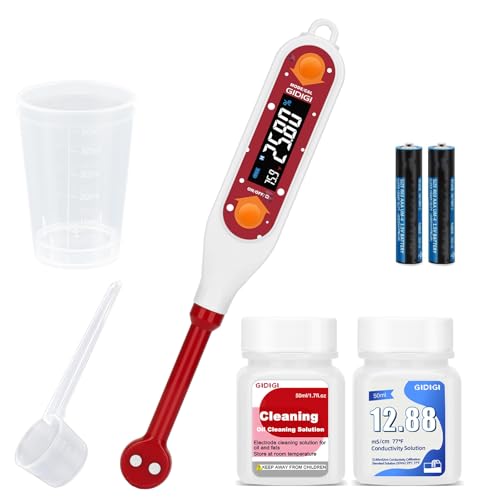
- 0.01%-26.00% food salinity range
- Also measures EC, TDS, temperature, and specific gravity
- Includes calibration and cleaning solutions
Best For: Home cooking, fermentation, and marine aquarium monitoring
Best Dedicated Pool Pick
SALT-3050 Waterproof Salt Meter

- Designed for saltwater pools and koi ponds
- Reads 0-9999 ppm or 0.0-1.0%
- IP65 waterproof and precalibrated
Best For: Saltwater pool and koi pond maintenance
Best Multiparameter Pick
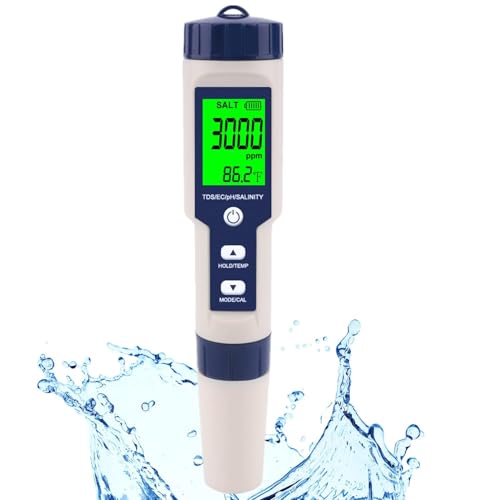
- Combines salinity, TDS, EC, pH, and temperature
- Supports pool, seawater, and food testing
- Displays salinity in ppm, ppt, and percentage
Best For: Multi-purpose pool, aquarium, spa, hydroponic, and kitchen testing
Best Budget-Friendly Pick – ORAPXI 4-in-1 Salinity Tester
For shoppers seeking portable salinity meters for routine aquarium, pond, pool, or seawater checks, the ORAPXI offers a broad measurement range in a compact waterproof design. Its backlit display and automatic temperature compensation make quick readings easier in changing conditions.
Best For: Aquarium owners, koi pond keepers, and users who want salinity, TDS, EC, and temperature readings in one handheld tester.
Pros:
- Measures salinity, TDS, EC, and temperature.
- Supports readings from 0–200 ppt, with additional ppm and percentage ranges.
- IP67 waterproof housing, green backlit LCD, and automatic temperature compensation.
Cons:
- Designed for regular water-solution testing rather than documented lab-grade field measurement.
- The supplied notes do not specify included calibration accessories or data logging.
The ORAPXI is a practical choice when versatility and easy readability matter more than advanced recordkeeping. Its wide range and multiple measurement modes suit everyday water checks across several settings.
Best Professional Field Kit – Apera SX731 Multiparameter Meter
Among portable salinity meters, the Apera SX731 is the most comprehensive option for users who need broader water-quality analysis in the field. It supports multiple parameters, recognizes connected electrodes automatically, and stores measurement data for later recall.
Best For: Field technicians, environmental monitoring, and users who need salinity testing alongside pH, ORP, conductivity, TDS, resistivity, dissolved oxygen, and temperature measurements.
Pros:
- Designed to measure up to seven water-quality parameters.
- Includes pH, conductivity, and ORP probes.
- Offers automatic calibration, temperature compensation, self-diagnosis, and 300 data-storage records.
Cons:
- At 3.27 pounds, it is less pocket-friendly than simpler testers.
- Its broader capabilities may be more than needed for basic salinity checks.
The SX731 is best viewed as a portable multiparameter platform rather than a dedicated salinity pen. Choose it when measurement breadth and stored field data are priorities.
Best Refractometer Option – Agriculture Solutions Marine Refractometer
This optical refractometer is a straightforward alternative to electronic portable salinity meters for seawater and marine aquarium testing. It measures salinity on a 0–100 ppt scale and includes automatic temperature compensation for more convenient routine use.
Best For: Marine fishkeeping and aquarium users who prefer a manual refractometer with specific-gravity and parts-per-thousand scales.
Pros:
- Measures salinity from 0–100 ppt.
- Displays both specific gravity and parts per thousand.
- Includes a hard case, dropper, screwdriver, manual, and cleaning cloth.
Cons:
- It does not provide electronic readings or additional parameters such as TDS and EC.
- Users must apply a water sample and read the optical scale.
For marine aquariums, this model keeps the process simple and provides the two scales commonly used for saltwater management. Its included accessories also make storage and basic maintenance convenient.
Best Pocket Tester With Replaceable Probe – Apera EC60 Conductivity/TDS/Salinity Tester
The Apera EC60 is a compact choice among portable salinity meters, with one-tap switching between conductivity, TDS, and salinity. Its replaceable platinum-black probe, automatic calibration, and IP67 waterproof housing make it well suited to repeated field or aquarium testing.
Best For: Users who want a durable pocket tester with salinity, conductivity, and TDS modes, plus a replaceable probe for longer-term use.
Pros:
- Switches easily among conductivity, TDS, and salinity measurements.
- Provides automatic calibration and automatic temperature compensation from 0–50°C.
- Includes calibration solutions, bottles, batteries, lanyard, carrying case, and a replaceable probe.
Cons:
- Its listed measured parameters do not include pH.
- The supplied notes do not state a dedicated salinity range.
The EC60 is a strong fit for routine users who value portability, repeatable calibration, and serviceability. Its replaceable probe and waterproof construction add practical advantages over basic disposable-style testers.
Easy-Read Portable Salinity Meter – AR8012 Digital Salinity Tester
For straightforward water checks, this portable salinity meter covers common monitoring tasks without adding unnecessary complexity. It measures salinity across 0.00–9.99 ppt and 10.0–50 ppt ranges, includes automatic temperature compensation, and has a backlit display for low-light use.
Best For: Water-source monitoring, aquaculture, and users who want replaceable probes in a compact pen-style tester.
Pros:
- Measures salinity from 0.00 to 50 ppt across two ranges.
- Automatic temperature compensation supports more consistent readings.
- Replaceable plug-in electrode probes simplify sensor replacement.
- Backlit LCD, switchable °C/°F readings, and five-minute auto shutoff.
Cons:
- Its listed salinity range is narrower than some multiparameter or specialized testers.
- The supplied notes do not indicate measurements for pH, conductivity, or TDS.
The AR8012 is a practical choice when salinity is the main measurement and portability matters. Its replaceable probe and simple controls are especially useful for routine field or facility checks.
Multiparameter Portable Salinity Meter – Apera PC60 5-in-1 Pocket Tester
The Apera PC60 is a portable salinity meter for buyers who also need broader water-quality data. Along with salinity, it measures pH, EC, TDS, and temperature, with a waterproof pocket design, dual display, and included calibration and storage supplies.
Best For: Aquarists, water-quality users, and field testers who need salinity alongside pH, conductivity, TDS, and temperature.
Pros:
- Combines five measurements in one pocket tester: pH, EC, TDS, salinity, and temperature.
- Replaceable multiparameter probe is designed for easy installation.
- Large backlit LCD shows temperature with the selected measurement and indicates calibration and stable readings.
- Includes calibration solutions, storage solution, batteries, lanyard, and carrying case.
Cons:
- Its broader feature set may be more than needed for salinity-only testing.
- The supplied notes do not provide a specific salinity measuring range or accuracy figure.
Choose the PC60 when consolidating several water tests is more valuable than using a single-purpose instrument. The included accessories and two-year instrument warranty also make it a well-equipped kit for recurring measurements.
3-in-1 Portable Salinity Meter – Digital Saltwater Tester with Specific Gravity
This portable salinity meter is designed for quick saltwater checks in aquariums, pools, hydroponics, and aquaculture. It measures salinity, specific gravity, and temperature, with automatic temperature compensation, a backlit LCD, audible test beeps, and a life-waterproof pen-style body.
Best For: Aquarium and marine users who want salinity and specific-gravity readings in one compact tester.
Pros:
- Measures salinity from 0–55 ppt, specific gravity from 1.000–1.045, and temperature from 1–99 °C.
- Backlit display, automatic temperature compensation, and audible start and finish alerts support simple testing.
- Offers 0.1 ppt salinity resolution and 0.001 specific-gravity resolution.
- Includes automatic shutoff, low-battery indication, and a life-waterproof design.
Cons:
- The stated salinity accuracy is ±1 ppt, which may not suit applications requiring tighter tolerances.
- It uses two AAA batteries, adding a routine battery-maintenance step.
Its combination of salinity and specific-gravity measurements makes this tester particularly relevant to saltwater environments. The compact waterproof design is convenient for moving between indoor tanks and outdoor testing locations.
Best Kitchen & Fermentation Pick – Compact Food Salinity Meter
For shoppers comparing portable salinity meters, the GIDIGI GX-Salt1 is a versatile choice for food preparation, fermentation, and selected aquarium tasks. It measures salinity from 0.01% to 26.00%, uses conductivity technology with automatic temperature compensation, and provides readings in under 30 seconds.
Best For: Home cooks, fermentation projects, low-sodium meal planning, and users who also monitor marine aquariums.
Pros:
- Measures salinity, EC, TDS, temperature, and seawater specific gravity.
- Supports brines, soups, kimchi, sauerkraut, pickles, and other liquid foods.
- Compact 85-gram design includes a backlit display, lock-on reading, calibration solution, cleaning solution, and measuring cup.
Cons:
- Hot soup samples should be skimmed and tested below 176°F.
- Its broad feature set may be more than needed for food-only testing.
This is the strongest all-around option here for kitchen-focused testing because it combines a food-ready salinity range with useful water-measurement functions. The included accessories and one-handed design also make it convenient for repeated household use.
Best Dedicated Pool Pick – SALT-3050 Waterproof Salt Meter
The SALT-3050 is a specialized option among portable salinity meters, designed specifically for saltwater pools and koi ponds. It measures 0-9999 ppm or 0.0-1.0% salt, includes temperature measurement, and carries an IP65 waterproof rating.
Best For: Saltwater pool owners and koi pond keepers who want a dedicated salt-level tester.
Pros:
- Precalibrated at 3000 ppm NaCl at 77°F.
- Measures salt concentration in ppm or percentage.
- IP65 waterproof construction and compact form factor.
Cons:
- It is not intended for food, marine fish tanks, or other applications.
- Its temperature range is limited to 32-130°F.
Choose this meter when your testing needs are narrowly focused on saltwater pools or koi ponds. Its application limits are important, but within that use case, the precalibration and waterproof design keep operation straightforward.
Best Multiparameter Pick – Hofun 5-in-1 Salinity Tester
The Hofun 9909-A-1 stands out among portable salinity meters for users who want several water-quality readings in one device. It combines salinity, TDS, EC, pH, and temperature functions, with modes for pool salt, seawater, and food salinity testing.
Best For: Pool, aquarium, spa, hydroponic, and general water-quality testing where multiple parameters are useful.
Pros:
- Offers salinity readings in ppm, ppt, and percentage.
- Supports pool testing up to 9999 ppm, seawater testing from 10-200 ppt, and food testing from 0.01-25%.
- Titanium alloy probe and simple mode selection support quick testing.
Cons:
- Users seeking only salinity measurement may not need its extra functions.
- Food, pool, and seawater measurements use different ranges, so the appropriate mode must be selected.
This is the most flexible choice of the three for households or hobbyists managing different water environments. Its multiparameter design can reduce the need for separate meters, while the multiple salinity displays make results easier to interpret.
How We Picked the Best Portable Salinity Meters
We evaluated these Portable Salinity Meters by looking at the measurement range, supported parameters, stated accuracy, temperature compensation, waterproof rating, display and controls, calibration process, and intended use. We also separated instruments designed for seawater and aquariums from those intended for pools, ponds, agriculture, or food testing.
A broad range is useful for varied water sources, while a focused meter can be simpler for routine checks. Multiparameter models may cost more, but they can replace several separate instruments when you also need pH, conductivity, TDS, temperature, or ORP readings.
Quick Comparison
| Best For | Look For | Recommended Style |
|---|---|---|
| Marine aquariums and seawater | Salinity in ppt or specific gravity, ATC, waterproof housing | Dedicated digital meter or refractometer |
| Pool and pond maintenance | Salinity, pH, temperature, and EC in one device | Multiparameter tester |
| Aquaculture and field monitoring | Wide range, durable construction, clear calibration controls | Waterproof handheld meter |
| Food and brine testing | Food-specific calibration and a suitable salt range | Digital salinometer |
| Occasional low-cost testing | Simple operation and replaceable or accessible batteries | Basic pen-style tester |
Key Buying Factors for Portable Salinity Meters
Measurement Range and Units
Check whether the meter reports salinity as parts per thousand (ppt), parts per million (ppm), percentage, practical salinity units, or specific gravity. Make sure the range covers your actual samples without forcing you to estimate between unsuitable readings.
Accuracy, Calibration, and Temperature Compensation
Look for a stated accuracy that fits your application and confirm which calibration solutions are required. Automatic temperature compensation can improve consistency when sample temperature changes, but it does not replace proper calibration. Rinse the probe after every test and follow the manufacturer’s storage instructions.
Probe Design and Durability
Waterproof or water-resistant construction is valuable for pools, ponds, aquariums, and field use. Consider whether the probe is replaceable, how quickly it stabilizes, and whether the display is readable in your usual lighting. A protective cap and automatic shutoff can make regular testing easier.
Extra Parameters
If you already measure pH, conductivity, TDS, or temperature, a multiparameter unit may offer better value. However, more functions can mean more calibration steps and a less focused interface. Choose simplicity when salinity is your only requirement.
Who Should Buy Which Portable Salinity Meters?
Aquarium owners: Choose a seawater-focused meter or refractometer with suitable marine ranges and temperature compensation. Pool and koi pond owners: A waterproof combination tester with pH, EC, temperature, and salinity can reduce the number of tools you need. Aquaculture users: Prioritize a broad range, repeatable calibration, durable construction, and easy cleaning. Food users: Select a meter specifically designed for salt or brine rather than a water-quality instrument. Occasional testers: A simple pen-style model is usually sufficient if its range and calibration method match your samples.