The best food mills make it easier to turn cooked fruits and vegetables into smooth sauces, purées, soups, and baby food while separating skins, seeds, and fibers as you work.
We compared 10 manual and electric models by capacity, disc selection, construction, ease of use, and suitability for common kitchen tasks such as tomato processing, applesauce, and canning.
Best 10 Food Mills Picks for 2026
Best for Flexible Canning
Hungry Artisan 3-Disc Food Mill

- Three discs for coarse, medium, and fine textures
- Separates skins, seeds, and cores from applesauce
- Manual stainless steel design for canning and purees
Best For: Applesauce, tomato sauce, and seasonal canning
Best for Easy Handling
OXO Good Grips Stainless Steel Food Mill

- Stable non-slip legs fit pots and bowls up to 11 inches
- Three discs cover fine, medium, and coarse textures
- Foldable legs simplify storage
Best For: Purees and sauces prepared over a bowl or pot
Best for Large Batches

- Extra-large 6-quart stainless steel bowl
- Three discs measure 2mm, 3mm, and 4mm
- Non-slip handles and underside scraper aid processing
Best For: High-volume fruit and vegetable purees
Best Compact Everyday Pick
Cuisinart Stainless Steel Food Mill

- Three cutting discs for flexible puree textures
- Soft-grip handle and ergonomic turning design
- Durable stainless steel construction with 2.3-quart capacity
Best For: Everyday manual purees in small to medium batches
Most Versatile Manual Mill
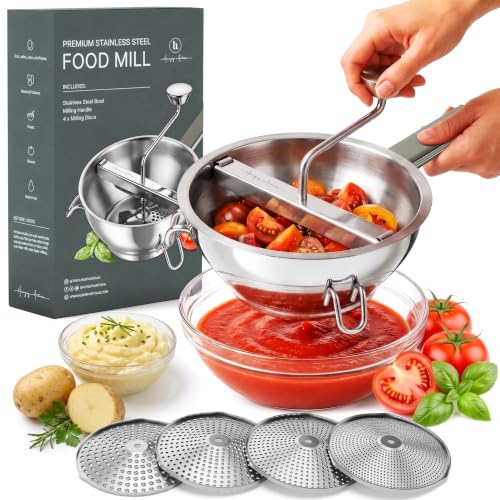
- Four stainless steel discs for fine-to-coarse results
- Comfortable spring-loaded crank with silicone grip
- Dishwasher-safe stainless steel body and secure hooks
Best For: Adjustable textures, everyday cooking, and preserving
Best Large-Batch Classic
3.5-Quart Stainless Steel Mill

- Generous 3.5-quart capacity for batch preparation
- Handles mashing, straining, grating, and ricing
- Designed for sauces, purees, tomatoes, apples, and potatoes
Best For: Large batches and straightforward everyday food processing
Best for High-Volume Processing

- 250-watt motor with forward and reverse speeds
- One-gallon hopper for bulk produce processing
- Three screens for tomatoes, vegetables, salsa, and purees
Best For: Canning, preserving, and large tomato harvests
Premium Stainless Steel Pick

- Efficient blade-and-sieve alignment
- Durable 18/10 stainless steel
- Stable 3-liter bowl-rest design
Best For: Cooks seeking a sturdy, high-capacity food mill
Most Versatile Set
Stainless Steel Food Mill with 3 Discs

- Three milling discs for varied textures
- Includes spoon, funnel, and measuring spoon
- Dishwasher-safe stainless steel design
Best For: Cooks who want accessories and multiple milling options
Simple Batch-Cooking Choice
- Practical 2-quart capacity
- Durable, easy-clean stainless steel
- Suitable for sauces, soups, and purees
Best For: Home cooks making small-to-medium batches
Best for Flexible Canning – Hungry Artisan 3-Disc Food Mill
If you want a versatile food mill for seasonal preserving, the Hungry Artisan 3-Disc Food Mill makes it easy to process apples, tomatoes, and other cooked foods by hand. Its three stainless steel discs let you choose a coarse, medium, or fine texture without needing an outlet.
Best For: Home cooks making applesauce, tomato sauce, baby food, purees, or jam bases during canning season.
Pros:
- Separates applesauce from skins, seeds, and cores as you crank.
- Includes coarse, medium, and fine stainless steel discs.
- Stainless steel body, discs, and crank are designed for repeated use.
- Manual operation works anywhere without electricity.
Cons:
- Manual cranking requires more effort than an electric appliance.
- At 2.8 pounds and 15.5 inches long, it may take substantial storage space.
This is a practical pick for cooks who want one sturdy, manual tool for both applesauce and a range of smooth or chunky preparations.
Best for Easy Handling – OXO Good Grips Stainless Steel Food Mill
The OXO Good Grips Stainless Steel Food Mill is a user-friendly choice for preparing hot purees and sauces. Its stainless steel bowl, spring-loaded disc lever, and non-slip legs are designed to make setup, texture changes, and serving more convenient.
Best For: Cooks who want a stable food mill for pureeing directly over bowls or pots up to 11 inches in diameter.
Pros:
- Includes fine, medium, and coarse stainless steel grinding discs.
- Non-slip legs help secure the mill over bowls and pots.
- Legs fold for easier storage.
- Approximately 2.3-quart capacity suits batches of purees and sauces.
Cons:
- Its capacity is smaller than the 6-quart Cuisipro model listed here.
- The hand-operated design still requires manual turning.
With a stable three-leg base and simple disc changes, this OXO model is a well-rounded food mill for routine kitchen use and hot-food preparation.
Best for Large Batches – Cuisipro Deluxe Food Mill
For cooks who process substantial quantities, the Cuisipro Deluxe Food Mill stands out with its extra-large 6-quart stainless steel bowl. Three interchangeable discs and an underside scraper help turn fruits and vegetables into puree while directing the results into the bowl or pot below.
Best For: Large-batch pureeing of fruits and vegetables for family meals, sauces, or preserving.
Pros:
- Large 6-quart capacity supports bigger batches.
- Includes 2mm, 3mm, and 4mm interchangeable discs.
- 18/10 stainless steel bowl is paired with non-slip handles.
- Underside scraper helps push puree into the bowl or pot below.
Cons:
- Its large 17-by-9-by-10-inch dimensions may be harder to store.
- At about 1,322 grams, it is heavier than some smaller food mills.
This Cuisipro is the strongest fit when batch size matters more than compact storage, especially for cooks preparing large amounts of fruit or vegetable puree.
Best Compact Everyday Pick – Cuisinart Stainless Steel Food Mill
The Cuisinart Stainless Steel Food Mill offers a straightforward manual design for everyday puree work. Its 2.3-quart capacity, three cutting discs, soft-grip handle, and ergonomic turning design provide useful control without adding an electric motor to your kitchen.
Best For: Home cooks seeking a compact manual food mill for fine, medium, or coarse purees.
Pros:
- Three cutting discs provide fine, medium, and coarse results.
- Durable stainless steel construction.
- Soft-grip handle and ergonomic design support smoother turning.
- Compact 2.3-quart capacity is suitable for everyday batches.
Cons:
- Its 2.3-quart capacity is less suited to very large batches.
- Manual operation requires hand effort.
This Cuisinart is a sensible choice for cooks who want a durable, no-power food mill with flexible texture options and a manageable capacity.
Most Versatile Manual Mill – 4-Disc Texture Control
This Hungry Artisan food mill is a practical choice for cooks who want control over the texture of sauces, purees, mashed potatoes, applesauce, jams, and baby food. Its four interchangeable stainless steel discs range from fine to coarse, while the hand crank and stable support hooks help make batch prep more manageable.
Best For: Home cooks who want adjustable textures for everyday cooking, canning, and preserving.
Pros:
- Includes four discs, including an ultra-fine option for smooth textures.
- Stainless steel construction resists rust and corrosion and is dishwasher safe.
- Silicone-grip, spring-loaded crank is designed to reduce slipping and hand fatigue.
- Double-welded hooks help secure the mill over bowls and pots.
Cons:
- Manual operation requires more effort than an electric strainer for large batches.
- Capacity and dimensions should be checked to ensure a suitable fit for your cookware.
Choose this model if texture flexibility and comfortable manual operation matter more to you than powered processing. It is especially well suited to varied kitchen projects rather than one specific type of produce.
Best Large-Batch Classic – 3.5-Quart Stainless Steel Mill
Mirro 50025 Foley Stainless Steel Healthy Food Mill Cookware, 3.5-Quart, Silver -
Check Price On AmazonThe Mirro Foley food mill is a straightforward option for processing generous batches of tomatoes, apples, potatoes, and other fruits and vegetables. Its 3.5-quart capacity makes it useful for cooks preparing sauces and purees in quantity, while the stainless steel finish is designed for practical cleanup and repeated kitchen use.
Best For: Home cooks who regularly prepare larger batches of sauces, purees, and mashed foods.
Pros:
- Large 3.5-quart capacity supports batch cooking.
- Suitable for mashing, straining, grating, and ricing.
- Designed for tomatoes, apples, potatoes, sauces, and purees.
- Stainless steel finish is intended for durability and easier cleaning.
Cons:
- The supplied details do not list interchangeable discs or multiple texture settings.
- Its larger footprint may require more storage space.
This Mirro model makes sense when capacity and basic versatility are the priorities. It is a solid fit for batch-oriented preparation, though shoppers seeking several precise textures may prefer a model that explicitly includes multiple discs.
Best for High-Volume Processing – Electric Tomato Strainer
The Weston Deluxe Electric Tomato Strainer is the food mill alternative for cooks processing garden harvests or bulk produce. Its 250-watt motor, two speeds, one-gallon hopper, and reverse function are designed to move through tomatoes and soft fruits efficiently while separating skins and seeds for sauces, purees, jellies, and salsa.
Best For: Canning and preserving projects that involve large quantities of tomatoes, fruits, or soft vegetables.
Pros:
- 250-watt motor provides powered processing with forward and reverse speeds.
- One-gallon hopper supports larger batches without frequent refilling.
- Includes 1.5mm, 3mm, and 6mm stainless steel screens for different preparations.
- Designed to remove skins and separate seeds without coring.
Cons:
- Requires an AC power source and is less portable than a manual mill.
- Its 14-by-12-by-17-inch dimensions may require substantial storage space.
- The electric design is more specialized for straining produce than general manual milling.
For high-volume preserving, this Weston stands apart from hand-crank food mills by emphasizing speed, hopper capacity, and powered separation. The included screens also provide useful flexibility for smooth preparations and chunkier salsa or puree.
Premium Stainless Steel Pick – Rösle 16252 Food Mill
Rosle 16252 Stainless Steel Food Mill with Handle, Bowl Rests & 2 Grinding Disc Sieves
Check Price On AmazonFor shoppers comparing food mills for sauces, soups, jams, and mashes, the Rösle 16252 emphasizes efficient milling and dependable stability. Its 18/10 stainless steel construction and 3-liter capacity suit both everyday cooks and larger kitchen tasks.
Best For: Cooks who want a durable, high-capacity stainless steel food mill with stable bowl supports.
Pros:
- Blade-and-sieve alignment is designed for fast, efficient milling.
- 18/10 stainless steel is durable, hygienic, and neutral in taste.
- Three lower supports help hold the mill securely over a bowl.
- Includes two grinding disc sieves for different milling tasks.
Cons:
- At 1.25 kg, it is relatively substantial to handle and store.
- The supplied configuration includes two sieves rather than three.
Its seamless one-piece construction and generous 3-liter capacity make this a strong choice when stability and long-term stainless steel durability matter more than a lightweight design.
Most Versatile Set – Stainless Steel Food Mill with 3 Discs
This food mill stands out among food mills for its three interchangeable milling discs, included spoon, and additional funnel and measuring spoon. The stainless steel body, dual-hook support, and dishwasher-safe design make it a practical option for sauces, mashed potatoes, fruits, vegetables, and canning.
Best For: Home cooks who want multiple sieve sizes and useful accessories for varied food-preparation tasks.
Pros:
- Three milling discs handle fine-to-coarser preparation needs.
- Dual hooks and a soft-covered handle and crank help provide a stable grip.
- Includes a multifunctional spoon, wide-mouth funnel, and measuring spoon.
- Stainless steel construction is dishwasher-safe and easy to clean.
Cons:
- The product details do not specify a capacity.
- The blue spoon and accessory-focused design may be more than needed for simple milling.
With upgraded blades and three disc options, this is a flexible food mill for cooks who value versatility and convenient cleanup in one package.
Simple Batch-Cooking Choice – Mirro Foley 2-Quart Food Mill
Mirro 50024 Foley Stainless Steel Healthy Food Mill Cookware, 2-Quart, Silver -
Check Price On AmazonThe Mirro Foley is a straightforward food mill for preparing homemade tomato sauces, apple preparations, potato dishes, soups, and purees. Its 2-quart stainless steel construction provides useful batch capacity while keeping the design focused on everyday cooking.
Best For: Home cooks looking for a practical stainless steel mill for small-to-medium batches of sauces and purees.
Pros:
- 2-quart capacity is suited to batches of sauces, soups, and purees.
- Durable stainless steel construction is easy to clean.
- Works with tomatoes, apples, potatoes, and other common ingredients.
- Simple design supports general home cooking.
Cons:
- The supplied notes do not indicate multiple interchangeable discs.
- Its 2-quart capacity is smaller than the 3-liter Rösle model.
If you prefer a no-frills food mill for regular homemade sauces and purees, the Mirro Foley offers useful capacity and durable stainless steel without emphasizing extra accessories.
How We Picked the Best Food Mills
We focused on the features that most affect real-world preparation: the number and size of interchangeable discs, bowl capacity, crank or motor design, stability, cleanup, and the types of foods each mill is intended to handle. Stainless steel construction is generally preferred for durability and compatibility with acidic ingredients, while a comfortable handle and secure bowl rests can make extended batches easier.
The selection includes compact mills for occasional purées, larger options for family-size batches, and an electric tomato strainer for cooks who value speed over a fully manual process. Product descriptions and listed specifications were also considered when comparing included accessories and intended uses.
Quick Comparison of These Food Mills
- Best for versatility: Choose a model with three or more discs for adjusting texture across sauces, mashed foods, jams, and baby food.
- Best for tomato sauce: Look for a wide bowl, efficient scraping action, and a disc designed to separate seeds and skins.
- Best for large batches: A 3-quart-plus capacity can reduce refilling during canning or harvest-season cooking.
- Best for speed: An electric strainer can process tomatoes with less manual cranking, though it requires storage space and access to an outlet.
- Best for occasional use: A smaller manual mill is easier to store and typically offers straightforward operation.
Key Buying Factors for Food Mills
Disc Selection
Disc size controls texture. Fine discs are useful for silky sauces and baby food, while medium or coarse discs can produce rustic applesauce, vegetable purées, or thicker preparations. Multiple discs provide more flexibility but may require extra storage.
Capacity and Stability
Match the bowl size to your typical batch. Larger mills are helpful for canning but can be heavier when full. Bowl rests, legs, or a secure handle position matter because a stable mill is safer and less tiring to operate.
Construction and Cleanup
Stainless steel is durable and easy to sanitize, especially when processing tomatoes or other acidic foods. Check whether the discs and moving parts are removable and dishwasher-safe. A simpler design may be preferable if quick cleanup is a priority.
Manual Versus Electric Operation
Manual mills are quiet, compact, and useful without electricity, but they require repeated cranking. Electric models can save time during large tomato batches while adding motor noise, counter space, and more parts to maintain.
Who Should Buy Which Food Mills?
Home canners and gardeners should prioritize capacity, durable metal construction, and several discs. Cooks making occasional applesauce or baby food may prefer a compact manual model that stores easily. Sauce enthusiasts should choose a fine disc and a bowl that accommodates enough cooked produce for their usual recipe. If processing speed is the top concern, an electric tomato strainer is worth considering; for maximum flexibility and simpler storage, a multi-disc manual mill is the better fit.