Making cider, wine, and fresh juice at home is easier with the right fruit press. The best model depends on your batch size, available storage, preferred materials, and how much manual effort you want to use.
We’ve selected 10 fruit presses ranging from compact 1.59-gallon designs to a 40-liter hydraulic press, giving home brewers practical options for occasional pressing and larger harvests.
Best 10 Fruit Presses for Home Use Picks for 2026
Best Wooden Press for Small Batches
4.75-Gallon Manual Fruit Press

- Solid beechwood basket
- Quiet, motor-free operation
- Built-in spout and stable stand
Best For: Small-batch home juice and wine making
Best Fruit Crusher for Home Brewing

- Processes up to 35–45 kg per hour
- 304 stainless steel construction
- Creates uniform press-ready fruit pieces
Best For: Preparing apples and pears for cider pressing
Best Large Wooden Press
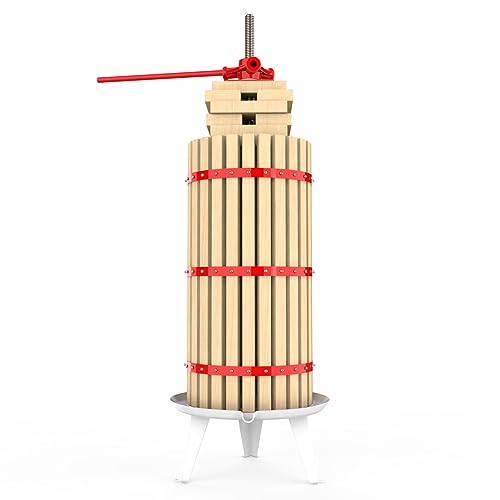
- Larger 7.9-gallon capacity
- Beechwood basket with removable pulp access
- Heavy-duty stand with pour spout
Best For: Larger seasonal fruit and wine-making batches
Best Hydraulic Fruit Press
40-Liter 5-Ton Stainless Steel Press

- Large 40-liter capacity
- 5-ton hydraulic pressing force
- 304 stainless juice-contact components
Best For: High-volume home, orchard, and harvest-season pressing
Classic Beechwood Press

- Solid beech wood basket with breakaway design
- Manual, quiet operation with built-in pour spout
- Suitable for apples, grapes, berries, and wine making
Best For: Traditional home cider and juice batches
Heavy-Duty Stainless Press
3.69-Gallon T-Handle Fruit Press

- Stainless steel body with heavy-duty cross-beam
- Large barrel and screw mechanism support efficient extraction
- Designed for apples, grapes, berries, cider, and wine
Best For: Durable home or small-scale pressing
Compact Triangular Press
6-Liter Stainless Steel Manual Press
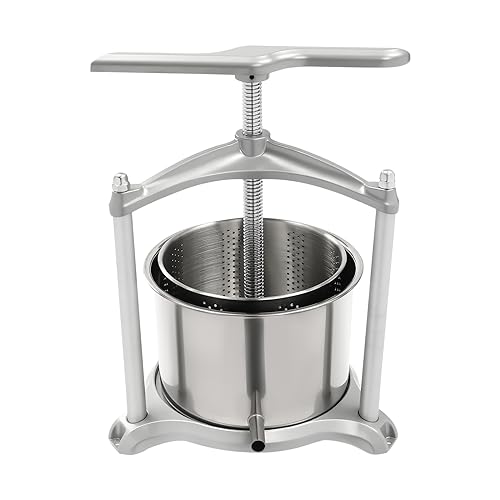
- Compact 6-liter capacity for smaller batches
- Stable triangular base with three support columns
- Includes filter bag, silicone hose, and manual
Best For: Space-conscious home and farm pressing
Best Wooden Press

- Natural beechwood basket and stable triangular base
- Eight support blocks aid juice extraction
- Includes two food-grade filter bags
Best For: Moderate home batches and buyers who prefer a wooden press
Best Large-Capacity Press
14L Stainless-Steel Fruit Press

- Large 14-liter capacity for abundant batches
- Removable 304 stainless-steel basket
- Swing-open crossbeam and stable triangular base
Best For: High-volume home pressing, gatherings, and small-scale production
Best Mid-Size Press
9L Stainless-Steel Fruit Press

- Moderate 9-liter capacity for home batches
- Removable stainless-steel basket aids cleanup
- Stable triangular base with T-handle operation
Best For: Regular medium-size batches without the largest press footprint
Best Wooden Press for Small Batches – 4.75-Gallon Manual Fruit Press
If you want fruit presses for home use that emphasize traditional, quiet operation, this 4.75-gallon model combines a solid beechwood basket with a heavy-duty stand. It is sized for apples, grapes, and berries, with a built-in spout to help direct juice into a container.
Best For: Home users making juice or wine from seasonal fruit in small to moderate batches.
Pros:
- Solid red beech basket is designed for moisture and wear resistance.
- Manual pressing requires no motor and operates quietly.
- Built-in pour spout and optional foot mounting holes support stable, cleaner operation.
Cons:
- Hand washing is required.
- Fruit must be crushed before loading into the press.
- The 4.75-gallon capacity may be limiting for larger harvests.
Its removable basket design can make pulp clearing more convenient between pressing cycles. Choose it if a compact, traditional wooden press suits your batch size and workflow.
Best Fruit Crusher for Home Brewing – 7-Liter Manual Apple Crusher
Among fruit presses for home use, this manual crusher is designed to prepare fruit before pressing rather than extract juice by itself. Its 7-liter hopper produces uniform pieces from apples and pears, making the pulp easier to process into juice or cider.
Best For: Home brewers and gardeners who need an efficient fruit-crushing step for cider pressing.
Pros:
- 7-liter hopper can process approximately 35–45 kg of fruit per hour.
- Food-grade 304 stainless steel and a reinforced iron frame provide durable construction.
- Uniform 1/4-inch pieces are intended to press easily with minimal waste.
- Suitable for apples, pears, grapes, oranges, and other fruits.
Cons:
- It is a crusher or pulper, so a separate juice press is needed for extraction.
- Table-mount components require a suitable secure work surface.
- Hand washing is required.
This is a practical companion for a larger press, especially when consistent pulp size and faster preparation matter more than an all-in-one design.
Best Large Wooden Press – 7.9-Gallon Manual Fruit Press
For larger batches, this 7.9-gallon manual press offers the traditional feel of a beechwood basket with more capacity than a small home model. It is intended for apples, grapes, and berries, and uses a hand-operated press plate to extract juice without a motor.
Best For: Families, orchard owners, and seasonal home winemakers handling substantial fruit loads.
Pros:
- 7.9-gallon capacity accommodates larger pressing sessions.
- Solid beechwood basket is designed to resist moisture and wear.
- Heavy-duty stand includes a built-in pour spout for juice collection.
- Basket breaks away for easier pulp removal between batches.
Cons:
- Fruit must be crushed before pressing.
- Hand washing is required.
- Its larger capacity and approximately 27.6-inch height require adequate workspace.
The increased capacity makes this a stronger choice than a compact press when harvest volume is the priority. Its manual operation remains quiet and straightforward for home use.
Best Hydraulic Fruit Press – 40-Liter 5-Ton Stainless Steel Press
If you are comparing fruit presses for home use by capacity and pressing force, this hydraulic model stands out with a 40-liter chamber and a 5-ton jack. Its juice-contact components are made from AISI 304 stainless steel, making it suited to orchard harvests, home processing, and larger gatherings.
Best For: Users who want high-capacity pressing with hydraulic assistance for fruit, herbs, nut milks, or honey.
Pros:
- 40-liter/10.6-gallon capacity supports large batches.
- Hydraulic jack supplies up to 5 tons of pressing force.
- Juice-contact parts use AISI 304 stainless steel for durability and easier cleaning.
- Adjustable leg height and a 90-degree-turning beam improve container access and loading.
Cons:
- At 85 pounds, it is considerably less portable than smaller manual presses.
- Its 20-by-17.3-by-31.6-inch footprint requires substantial storage and operating space.
- The supplied notes do not indicate a motorized system; pressing is hydraulic.
This is the most substantial option in the group for high-volume work. Select it when capacity, force, and stainless juice-contact surfaces matter more than compact storage.
Classic Beechwood Press – 3.2-Gallon Manual Fruit Press
EJWOX 3.2 Gallon Fruit and Wine Press, Manual Cider Press with Solid Beech Wood Basket
Check Price On AmazonFor shoppers comparing fruit presses for home use, this 3.2-gallon model offers a traditional manual design with a solid red beech wood basket. Its hand-operated press plate is suited to apples, grapes, and berries when you want quiet operation and direct control over each batch.
Best For: Home cider, juice, and small-batch wine making with apples, grapes, or berries.
Pros:
- Solid beech wood basket is designed for durability and moisture resistance.
- Manual operation requires no motor and is quiet during use.
- Built-in pour spout and optional foot mounting holes support easier, steadier collection.
- Breakaway basket design helps remove pressed pulp between batches.
Cons:
- Hand-wash-only care requires manual cleanup.
- Its 3.2-gallon capacity may be limiting for larger-scale pressing.
- The wooden basket may require more care than an all-metal design.
This is a practical choice if you prefer the look and feel of a classic wooden press and want a stable unit for seasonal household batches. The included manual workflow is straightforward, though its capacity and hand-wash care are worth considering.
Heavy-Duty Stainless Press – 3.69-Gallon T-Handle Fruit Press
This stainless steel model is a strong contender among fruit presses for home use when durability and batch size are priorities. Its heavy-duty cross-beam, T-handle, and screw mechanism are designed to support efficient juice extraction from apples, grapes, berries, and other fruits.
Best For: Home brewers and small-scale users who want a durable press for juice, cider, or wine making.
Pros:
- Stainless steel construction is built for durability and repeated use.
- 3.69-gallon barrel provides a generous capacity for home batches.
- Heavy-duty cross-beam design helps provide stability during pressing.
- Can be rinsed with a hose for easier cleanup between batches.
Cons:
- At 33.1 pounds, it is relatively heavy to move and store.
- Its 19-by-19-inch footprint requires dedicated storage space.
- Manual pressing still requires physical effort despite the efficient screw mechanism.
Choose this press if you value stainless steel construction and a slightly larger capacity than compact household models. Its weight and footprint make it better suited to a designated work area than frequent carry-and-store use.
Compact Triangular Press – 6-Liter Stainless Steel Manual Press
For smaller batches, this 6-liter stainless steel press is a compact option among fruit presses for home use. It combines a triangular base, three-column support, ergonomic T-handle, perforated basket, filter bag, and silicone hose for controlled manual juice extraction.
Best For: Compact home, farm, apiary, or food-preparation setups handling modest quantities of fruit and other soft ingredients.
Pros:
- Stainless steel and aluminum construction offers rust resistance and sturdiness.
- Triangular base and three columns help keep the press stable during operation.
- Includes a filter bag, silicone hose tube, and English instruction manual.
- Press plate is designed to fit closely against the perforated basket for reduced leakage.
Cons:
- Its 6-liter capacity is smaller than the other presses in this roundup.
- Hand-wash-only care may make cleanup more involved.
- Manual operation requires effort for each pressing cycle.
This model makes sense when counter space and batch size matter more than maximum throughput. Its stable base and included accessories add convenience, while the compact 6-liter capacity keeps it oriented toward household-scale work.
Best Wooden Press – 6L Beechwood Fruit Press
For shoppers comparing fruit presses for home use, this 1.6-gallon VEVOR model offers a compact manual setup with a natural beechwood basket and included filter bags. Its progressive screw mechanism and reinforced pressing blocks are designed for extracting juice from prepared apples, grapes, and other suitable produce.
Best For: Families and home users who want a sturdy wooden press for moderate batches of juice, cider, fruit wine, pulp, or similar ingredients.
Pros:
- Natural beechwood basket with a stable triangular base.
- Eight supporting blocks and a thick pressing block help improve extraction.
- Extended handle and spiral mechanism make manual pressing more manageable.
- Includes two food-grade filter bags.
Cons:
- Hard fruits must be crushed before pressing.
- Hand-wash-only care requires additional cleanup.
- At 15.9 pounds, it is not especially lightweight to move.
This is a practical choice when the look and feel of a wooden basket appeal to you and a 6-liter capacity is sufficient. Consider a larger stainless-steel model if you regularly process bigger harvests or prioritize a removable, easy-clean basket.
Best Large-Capacity Press – 14L Stainless-Steel Fruit Press
This 3.69-gallon VEVOR is one of the larger fruit presses for home use, making it suitable for processing substantial batches of prepared fruit. Its removable 304 stainless-steel basket, cast-iron crossbeam, and triangular base focus on durability, stability, and easier cleanup.
Best For: Large family gatherings, home winemaking, farms, restaurants, and anyone processing abundant apple or grape batches.
Pros:
- Generous 14-liter capacity for larger batches.
- Removable 304 stainless-steel basket simplifies cleaning.
- Swing-open crossbeam makes loading more convenient.
- Includes two food-grade filter bags and a T-shaped anti-slip handle.
Cons:
- Fruits should be pre-crushed for best results.
- At 34 pounds and nearly 38.4 inches tall, it requires substantial storage space.
- Non-food-contact metal parts need food-grade lubricant to help prevent corrosion.
The large basket and removable stainless-steel construction make this the strongest fit for high-volume pressing and users who value cleanup convenience. Its size and weight are less suitable for occasional, small-batch kitchen use.
Best Mid-Size Press – 9L Stainless-Steel Fruit Press
For shoppers seeking a middle ground among fruit presses for home use, this 2.38-gallon VEVOR model offers more capacity than a small countertop-style press without reaching the footprint of the 14-liter version. Its screw-driven handle, triangular base, and removable stainless-steel basket support controlled, manual pressing.
Best For: Home users who want a moderate-capacity press for apple, grape, orange, and similar fruit preparations.
Pros:
- 9-liter capacity balances batch size and overall scale.
- Removable 304 stainless-steel basket is designed for easier cleaning.
- Cast-iron crossbeam and triangular base provide a sturdy setup.
- T-handle and large pressing plate support straightforward manual operation.
Cons:
- Pre-crushing fruit is recommended for the best pressing results.
- Its 31.1-pound weight and roughly 27.8-inch height may limit portability.
- Metal components require care, including lubrication of non-food-contact parts.
This model is a sensible compromise for households that need more than a small press but do not need the full 14-liter capacity. Choose it for recurring medium-size batches, while occasional users may prefer a lighter and smaller design.
How We Picked the Best Fruit Presses for Home Use
We compared these presses by capacity, construction, pressing mechanism, juice-contact materials, stability, and likely cleaning demands. Manual screw presses are generally affordable and straightforward, while hydraulic models can produce substantial pressure with less physical effort. We also considered whether each design suits apples, grapes, berries, honey, or other soft and prepared fruit.
Capacity matters, but larger is not automatically better. A compact press is easier to store and may be more practical for small batches. Larger baskets reduce the number of loading cycles when processing fruit from a garden or orchard.
Quick Comparison
| Best For | Recommended Capacity | Press Style |
|---|---|---|
| Small kitchen batches | 1.5–2.5 gallons | Compact manual press |
| Regular cider making | 3–5 gallons | Manual basket press |
| Large home harvests | 6–8 gallons | Heavy-duty manual press |
| High-volume pressing | 10 gallons or 40 liters | Hydraulic press |
Key Buying Factors for Fruit Presses for Home Use
Capacity and Batch Size
Choose a basket that matches the amount of prepared fruit you typically process. A small press helps avoid wasted space and is easier to handle, while a larger basket saves time during harvest season. Remember that fruit usually needs crushing or pulping before pressing.
Construction and Juice Contact Surfaces
Stainless steel baskets are durable, nonporous, and relatively easy to sanitize. Beech wood baskets are traditional and sturdy but require careful washing and thorough drying. Check the frame, base, and pressing plate for solid construction, especially if you plan to apply significant force.
Pressing Mechanism and Stability
Screw presses offer simple operation and do not require power. Cross-beam and T-handle designs can provide good leverage, but a stable triangular or heavy-duty base is important. Hydraulic presses reduce manual effort and may suit larger batches, though they usually cost more and take up more storage space.
Cleaning and Preparation
Look for removable baskets, included filter bags, and smooth surfaces with few crevices. Wash the press promptly after use and follow the manufacturer’s care instructions. A fruit crusher or scratter may also be necessary for apples and other firm fruit because a press alone will not extract efficiently from whole pieces.
Who Should Buy Which Fruit Presses for Home Use?
Choose a compact 1.59- to 2.38-gallon model for occasional juice, honey, or small cider batches. A 3.2- to 4.75-gallon press is a versatile choice for most households and hobby brewers. Move up to a 6- to 7.9-gallon design if you regularly process garden or orchard harvests. For frequent, high-volume pressing with less hand effort, a 40-liter hydraulic model is the strongest fit.