Pinless Moisture Meter review searches usually split between simple home-use tools and more capable inspection meters.
This one sits closer to the practical end of that spectrum.
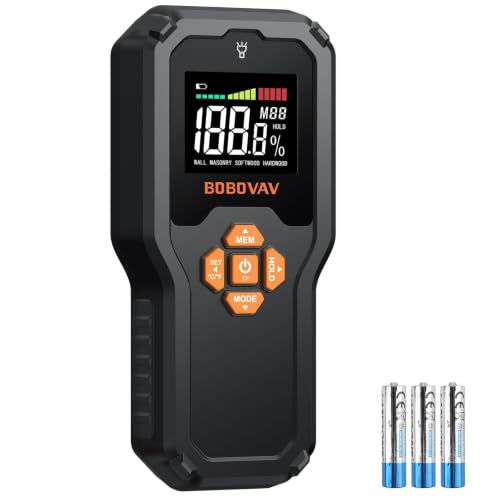
Pinless Moisture Meter Review Summary
The Pinless Moisture Meter makes sense for buyers who want a non-destructive way to check wood, walls, drywall, masonry, or finished surfaces without leaving holes behind.
Its strongest case is not glamour; it is the combination of a 19 mm sensing depth, adjustable alarm thresholds, saved readings, and an interface designed for repeated checks across a job site or around the house.
If you are comparing moisture meters because you are trying to catch leaks, monitor drying, inspect before renovation, or document multiple readings in one session, this model has the right feature mix.
It is especially appealing when you want a tool that can flag risky areas quickly instead of forcing you to stare at a single number and manually track everything.
Review Scorecard
| Category | Score | Why it scores that way |
|---|---|---|
| Non-destructive usability | 9 | Pinless sensing avoids piercing finished surfaces and suits floors, tiles, drywall, and masonry. |
| Inspection depth | 8 | The 19 mm sensing depth is useful for routine checks and pre-renovation screening. |
| Reading management | 8 | Data memory for up to 15 readings helps when you need to compare spots. |
| Alerting and workflow | 9 | Adjustable thresholds plus light and sound alarms make it easy to spot trouble. |
| Surface versatility | 8 | Wood, wall, drywall, concrete, and masonry use cases broaden its value. |
| Field convenience | 8 | The handheld body and built-in flashlight make dark or tight spaces easier to inspect. |
| Overall buyer fit | 8 | Strong for homeowners and tradespeople who want quick, repeatable moisture checks. |
Bottom line: this is a sensible pick if you care more about practical inspection workflow than about a stripped-down one-button tool.
Key Features and Specifications of Pinless Moisture Meter
The listing describes a pinless moisture meter with a maximum sensing depth of 19 mm and stated ±4% accuracy across four detection modes.
That matters because the tool is not limited to a single material type or a single style of inspection.
It is built to help you check wood and wall materials, then switch context when the job changes.
The other standout feature is the data memory.
The meter can store up to 15 readings across the four detection settings, which is useful when you are scanning multiple points in a room, comparing a suspect patch against surrounding areas, or logging a drying pattern after a leak.
For many buyers, that is more useful than a larger screen or a fancier casing.
The alarm system is also more flexible than the average basic meter.
You can set a custom warning threshold for each detection mode, with the manual alarm value adjustable within 10 percent to the upper limit of each range.
When readings cross the threshold, the device uses sound and light alerts backed by a high-contrast LCD with green, yellow, and red indicators.
Other published details worth noting:
- Non-invasive pinless sensing for finished surfaces
- Four detection modes
- Data hold function
- Built-in flashlight
- Switchable Celsius and Fahrenheit temperature display
- Handheld size: 152.6 x 71.6 x 31.7 mm
The feature set points to a tool meant for repeated checks, not just one-off curiosity reads.
That is the right design choice for a meter in this category.
Pros and Cons of Pinless Moisture Meter
Pros
- Non-destructive testing is the main advantage. You can press it against finished surfaces without leaving marks.
- Custom alarm thresholds help tailor the tool to different materials or project standards.
- Saved readings make it easier to compare multiple spots without writing everything down.
- Light and sound alerts reduce the need to watch the screen constantly.
- Built-in flashlight improves usability in basements, cabinets, and other low-light areas.
- Multiple use cases across wood, drywall, walls, and masonry make it more versatile than a single-purpose moisture checker.
Cons
- It is still a screen-and-alarm utility, not a diagnostic instrument with advanced analysis.
- The 15-reading memory is useful, but not large enough for long documentation-heavy surveys.
- The listing is strong on features, but it does not provide much detail about the exact workflow differences between the four modes.
- Buyers who only need an occasional spot check may not use the threshold controls or memory features often enough to justify the extra capability.
Overall, the positives line up well with the intended use.
The drawbacks are real, but they are mostly limits of the category rather than flaws unique to this meter.
Who Should Buy Pinless Moisture Meter?
This Pinless Moisture Meter is a good fit for homeowners, remodelers, property managers, and maintenance workers who want quick moisture checks without damaging surfaces.
It also makes sense for anyone who regularly inspects around sinks, bathrooms, basements, or other places where hidden dampness can turn into bigger repair work.
It is particularly useful if you want to compare one area against another, keep a short record of readings, or set a custom alarm for a specific material or project standard.
The memory and threshold controls are the kind of features that pay off when you use the tool more than once.
You should probably skip it if you only want a very basic occasional meter and do not care about stored readings or configurable alerts.
If your workflow depends on deeper technical reporting, this is also not the right level of tool.
In short, buy it if you want a practical inspection meter with better workflow control than the cheapest pinless options.
Moisture Detection Workflow and Real-World Use
Finished Floors and Decorative Surfaces
The non-invasive design is the main reason to choose this meter over a pin-style model.
If you are checking a finished floor, decorative tile, or another surface you do not want to damage, pinless sensing is the cleaner approach.
That makes the tool feel better suited to preventative checks and post-leak screening.
Drying Checks and Threshold Tracking
The adjustable alarm threshold is a meaningful workflow upgrade.
Instead of deciding after the fact whether a reading looked high, you can set a limit and let the meter signal when an area crosses it.
That is useful when drying progress matters and you want a fast pass/fail style indicator during repeated inspections.
Memory for Multi-Point Surveys
The ability to store up to 15 readings is modest but useful.
It helps when you are moving through a room, comparing one wall section to another, or checking a series of boards or substrate areas.
For short inspections, that memory capacity is enough to make the meter feel organized instead of cumbersome.
Low-Light and On-Site Convenience
The flashlight and handheld size matter more than they sound.
Moisture checks often happen in dim basements, behind cabinets, near utilities, or under unfinished areas where visibility is poor.
A compact body with an integrated light is a practical advantage, not a gimmick.
Alternatives to Pinless Moisture Meter
If you want a different workflow or a stronger brand ecosystem, there are a few credible alternatives to compare on Amazon.
- General Tools moisture meter search
- Klein Tools moisture meter search
- Tacklife moisture meter search
- FLIR moisture meter search
General Tools and Klein Tools are sensible reference points if you want established utility-tool brands.
FLIR is worth comparing if you value a more inspection-oriented product line.
Tacklife is often considered by buyers looking for simpler, budget-friendly options with broad home-use coverage.
The main question is not which label looks best on the box.
It is whether you want pinless non-destructive testing, saved readings, and adjustable alarms.
If those matter, this meter stays competitive.
Is Pinless Moisture Meter Worth It?
Yes, for the right buyer. The Pinless Moisture Meter is worth considering if you want a non-destructive moisture checker with a better-than-basic workflow: deep-enough sensing for routine checks, custom warning thresholds, saved readings, and alerts that reduce guesswork.
It is not the most minimal option, and it is not pretending to be a laboratory instrument.
What it does offer is a strong balance of convenience and control for real-world inspection work.
If you regularly check wood, walls, drywall, or masonry and want a meter that helps you move quickly without marking surfaces, this is a solid buy.
If your needs are casual and infrequent, a simpler meter may be enough.