Making smooth tomato sauce, applesauce, salsa, or pumpkin purée is easier when a strainer separates skins and seeds while you work. The best manual food strainer machines combine efficient processing with sturdy construction, comfortable cranking, and simple cleanup.
This roundup compares 10 food mills, clamp-style strainers, and sauce makers across manual and electric designs. Use the guide below to match capacity, convenience, and budget to your preserving routine.
Best 10 Manual Food Strainer Machines Picks for 2026
Versatile Clamp Pick

- 1.3 mm screen for apples and tomatoes
- Clamp fits 3/4- to 2-1/8-inch countertops
- Optional motor and specialty screens available
Best For: Versatile countertop sauce and puree preparation
Classic Sauce-Making Choice
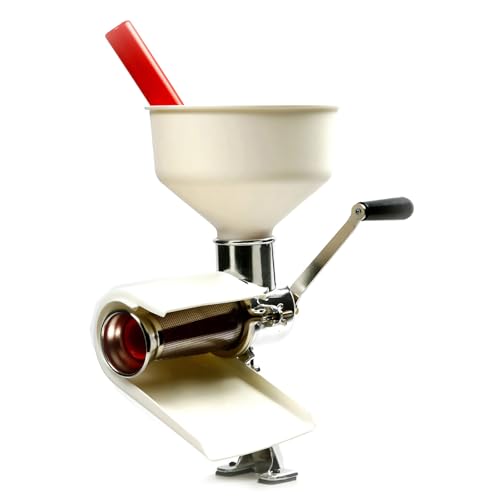
- 3-quart capacity
- Separates juice and pulp in one operation
- Includes fine mesh screen and standard spiral
Best For: Traditional fruit, vegetable, and puree straining
High-Capacity Prep Pick
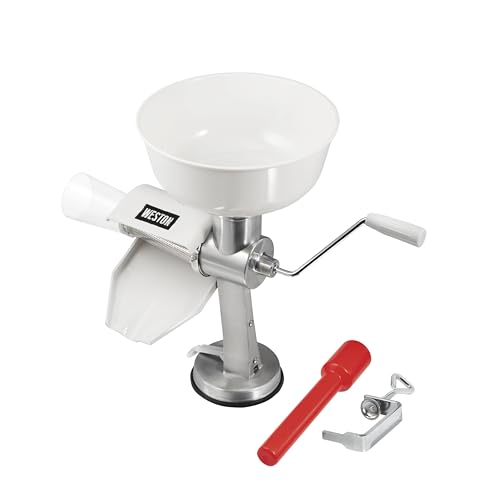
- Hopper holds approximately one gallon
- Suction-cup or C-clamp mounting
- Includes 1.5 mm stainless steel screen
Best For: Large-batch canning, preserving, and juice making
Texture-Control Pick
Hungry Artisan 3-Disc Food Mill

- Three discs for coarse, medium, and fine textures
- No outlet needed for hand-crank operation
- Stainless steel body, discs, and crank
Best For: Portable, texture-adjustable applesauce and puree making
Best Electric Batch Strainer

- Powered motor for continuous sauce making
- Four screens for varied textures
- Stainless steel construction with splatter cover
Best For: Large-batch sauces, purees, and canning
Best Compact Hand Mill
Stainless Steel Rotary Food Mill

- Three interchangeable milling discs
- Stable dual-hook hand-crank design
- Dishwasher-safe stainless steel body
Best For: Small-batch sauces, potatoes, jams, and produce
Best Versatile Hybrid Strainer

- Hand crank plus included electric motor
- Four screens for sauces and purees
- Clamp mount and five-year warranty
Best For: Flexible fruit and vegetable processing
Best with Extra Features

- 250-watt motor with forward and reverse speeds
- One-gallon hopper for larger home batches
- Three screens for sauces, purees, and chunky salsa
Best For: Home canning and garden-harvest processing
Best Commercial-Style Strainer
VBENLEM 370W Tomato Milling Machine
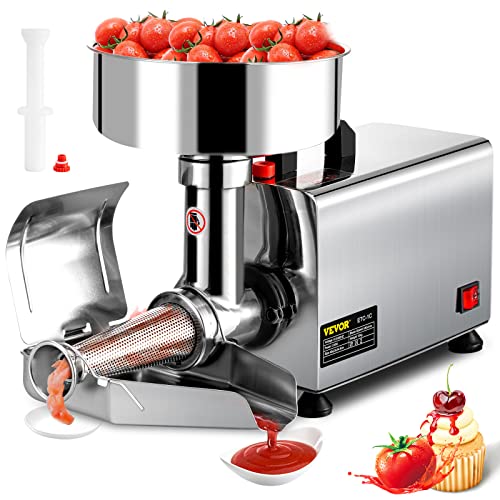
- 370-watt pure copper motor
- 304 stainless-steel food-contact parts
- Nine-inch funnel and adjustable discharge trough
Best For: Frequent, high-volume sauce and jam processing
Best for Harvest Season

- 370-watt motor for bulk sauce processing
- Large hopper limits refill interruptions
- Tool-free disassembly and stainless components
Best For: Bulk canning and frequent fruit processing
Versatile Clamp Pick – Johnny Apple Sauce Maker
For shoppers comparing manual food strainer machines, the Johnny Apple Sauce Maker stands out as a clamp-mounted option for separating skins and seeds while making sauces, purees, jams, juices, and more. Its 1.3 mm apple and tomato screen is ready to use out of the box.
Best For: Home cooks who want a versatile hand-crank strainer with secure countertop mounting and optional motor compatibility.
Pros:
- Handles fruits, vegetables, sauces, baby foods, soups, jams, and pie fillings.
- Includes an apple/tomato screen, standard spiral, and instruction manual.
- Clamp fits countertops from 3/4 to 2-1/8 inches thick.
- Includes a stated 5-year warranty, with BPA-free plastic components.
Cons:
- Optional electric motor and specialty screens are sold separately.
- Clamp mounting requires a suitable countertop edge.
This is a strong all-purpose choice if you value mounting stability and the option to expand the machine later with additional screens or a motor.
Classic Sauce-Making Choice – Norpro 1951 Sauce Master
The Norpro 1951 is a straightforward option among manual food strainer machines, using a hand crank to force fruits and vegetables through a chrome-plated steel screen while separating juice and pulp in one operation. It has a stated 3-quart capacity.
Best For: Cooks seeking a traditional hand-operated strainer for sauces, purees, fruits, and vegetables.
Pros:
- Designed for vegetables, fruits, and purees.
- Includes a fine mesh screen, standard spiral, recipe, and instruction booklet.
- Additional berry, pumpkin, and salsa screens are available separately.
Cons:
- Additional screens increase the overall accessory cost.
- Listed for hand washing only.
The Norpro makes sense for buyers who want a familiar, dedicated sauce maker with a useful standard setup and optional screen expansion.
High-Capacity Prep Pick – Weston Food Strainer
Weston Food Strainer and Sauce Maker for Tomato, Fresh Fruits and Vegetables ,White
Check Price On AmazonFor larger batches, the Weston Food Strainer and Sauce Maker is one of the more practical manual food strainer machines to consider. Its extra-large hopper holds approximately one gallon of produce, while the included 1.5 mm stainless steel screen separates skins and seeds from pulp.
Best For: Canning, preserving, winemaking, and batch preparation involving tomatoes, grapes, and other produce.
Pros:
- Extra-large hopper holds approximately one gallon of fruits or vegetables.
- Dual-mount system uses either a suction cup base or C-clamp.
- Includes a stomper and stainless steel multipurpose screen.
- Additional screen sizes are available for squash, salsa, and grapes.
Cons:
- Only a limited one-year manufacturer’s warranty is specified.
- Additional screens are needed for some specialty applications.
Its large hopper and flexible mounting system make this Weston model especially appealing when you want to process substantial quantities without committing to a single mounting style.
Texture-Control Pick – Hungry Artisan 3-Disc Food Mill
The Hungry Artisan 3-Disc Food Mill offers a different approach to manual food strainer machines, using interchangeable stainless steel discs instead of a single fixed screen. Its coarse, medium, and fine discs let you adjust the texture of applesauce, tomato sauce, purees, and other preparations.
Best For: Cooks who want portable, outlet-free straining with control over finished texture.
Pros:
- Three discs provide coarse, medium, and fine textures.
- Hand-crank operation requires no electrical outlet.
- Stainless steel body, discs, and crank are designed for repeated use.
- Works with applesauce, tomato sauce, mashed potatoes, baby food, purees, and jam bases.
Cons:
- It is a food mill rather than a high-capacity hopper-style strainer.
- Manual cranking is required for every batch.
This is a good fit when texture flexibility and easy placement matter more than a large hopper or motor-ready design.
Best Electric Batch Strainer – VEVOR 800W Tomato Sauce Maker
For shoppers comparing manual food strainer machines with powered alternatives, the VEVOR electric tomato strainer is built for faster, larger-batch processing. Its stainless steel screen separates skins and seeds in one pass, while multiple screens support different sauce and puree textures.
Best For: Large-batch tomato sauce, puree, salsa, jam, and harvest-season canning.
Pros:
- Steady DC motor supports continuous sauce making with high torque and low noise.
- Includes four screens for sauces, jams, purees, and salsa.
- 304 stainless steel parts resist fruit acids and wear.
- Guard cover helps reduce splatter, and removable components simplify rinsing.
Cons:
- Electric operation may be more equipment than occasional users need.
- At 7.2 pounds, it is less lightweight than a basic hand mill.
The VEVOR stands out when throughput matters more than traditional hand-crank control. Its screen variety and powered motor make it a practical choice for preserving substantial quantities of produce.
Best Compact Hand Mill – Stainless Steel Rotary Food Mill
Among manual food strainer machines, this stainless steel rotary food mill offers straightforward hand-crank control for sauces, mashed potatoes, jams, and produce. Its three interchangeable milling discs let you choose a finer or coarser result without relying on electricity.
Best For: Home cooks who want a compact manual mill for potatoes, tomato sauce, fruits, vegetables, and canning.
Pros:
- Three milling trays accommodate different textures and help remove seeds.
- Dual hooks and a silicone-covered crank support steadier operation over a bowl.
- Food-grade stainless steel construction is sturdy and dishwasher-safe.
- Includes a multifunctional spoon, funnel, and measuring spoon.
Cons:
- Manual cranking requires more effort than an electric strainer.
- Its bowl attachment depends on a suitable bowl or pan for stable use.
This model is a practical pick for smaller kitchen tasks where hands-on control, easy cleaning, and compact storage are priorities. The included accessories add flexibility for everyday preparation.
Best Versatile Hybrid Strainer – Johnny Apple Sauce Maker
For buyers seeking manual food strainer machines with optional powered assistance, the Johnny Apple Sauce Maker combines a long hand crank with an included electric motor. Its interchangeable screens and spirals are designed to separate skins and seeds for sauces, purees, juices, jams, and other produce preparations.
Best For: Cooks who want both hand-crank control and electric convenience for varied fruits and vegetables.
Pros:
- Can operate manually or with the included electric motor.
- Includes berry, apple/tomato, pumpkin, and salsa screens.
- Strong clamp mounts to countertops from 3/4 to 2-1/8 inches thick.
- Cast aluminum body, stainless steel screens, BPA-free plastic parts, and a five-year warranty.
Cons:
- The clamp-based design requires a compatible countertop edge.
- Its 8-pound body is relatively substantial for a manual strainer.
- The multiple screens and spirals may require more setup and storage space.
The Johnny Apple Sauce Maker is the most flexible option of the three for users who want traditional manual operation without giving up motorized help. Its broad accessory set also makes it suitable for experimenting with different produce and textures.
Best with Extra Features – Weston Deluxe Tomato Strainer
The Weston Deluxe is a practical choice for shoppers comparing manual food strainer machines but wanting electric assistance for larger sauce-making tasks. Its 250-watt, two-speed motor handles tomatoes and other soft produce, while the reverse setting helps reduce jamming.
Best For: Home gardeners and canners making sauces, purees, jellies, or salsa from moderate-to-large batches.
Pros:
- One-gallon hopper supports batch processing.
- Includes 1.5mm, 3mm, and 6mm stainless steel screens.
- Forward and reverse motor speeds improve processing flexibility.
- Stomper helps feed produce safely.
Cons:
- Its plastic and stainless-steel construction may be less suitable for heavy commercial use than an all-stainless machine.
- It requires access to a 120-volt AC power source.
With multiple screens and a generous hopper, this Weston model offers useful versatility for home preserving. It is a strong fit when convenience and recipe flexibility matter more than commercial-grade throughput.
Best Commercial-Style Strainer – VBENLEM 370W Tomato Milling Machine
The VBENLEM is designed for shoppers who need more capacity and a sturdier build than many manual food strainer machines provide. Its 370-watt pure copper motor, stainless-steel food-contact components, and large funnel are suited to processing tomatoes and soft fruit for sauces and jams.
Best For: High-volume sauce and jam preparation where durable construction and efficient feeding are priorities.
Pros:
- Food-contact parts are made from 304 stainless steel.
- 370-watt pure copper motor is built for demanding processing.
- Nine-inch funnel helps accommodate fruit feeding.
- Adjustable trough supports smoother sauce discharge.
Cons:
- At 22 pounds, it is relatively heavy to move and store.
- The machine is intended for 110-volt operation.
- Its commercial-style design may be more machine than occasional users need.
This VBENLEM model makes the most sense for frequent batch processing. Its stainless construction and larger motor favor durability and throughput, while the heavier frame may be less convenient for casual kitchen use.
Best for Harvest Season – VEVOR 370W Electric Food Mill
The VEVOR Electric Tomato Strainer is a useful alternative to manual food strainer machines when you need to process a large harvest with less hand effort. Its 370-watt motor, large hopper, and stainless-steel components are designed to separate peels and seeds while making sauce, puree, juice, and jam.
Best For: Bulk canning and frequent processing of tomatoes, fruit, and vegetables.
Pros:
- 370-watt motor supports high-volume sauce making.
- Large hopper reduces the need for frequent refills.
- Stainless-steel hopper, screen, tray, and guard resist fruit acids and wear.
- Core components disassemble without tools for easier cleaning.
Cons:
- Tomatoes should be cut into small pieces to help reduce clogging.
- Its approximately 21.7-pound weight may make storage less convenient.
- The supplied notes specify a stainless-steel filter screen but do not indicate multiple screen sizes.
For harvest-season workloads, the VEVOR emphasizes speed, capacity, and cleanup. It is a compelling choice for users who value durable stainless components and streamlined batch processing over compact storage.
How We Picked These Manual Food Strainer Machines
We focused on machines designed to separate skins, seeds, and pulp from cooked or softened produce for sauces, purées, jams, and canning. Our comparison considers straining performance, build quality, operating effort, stability, included screens or milling discs, cleanup, capacity, and the type of batches each machine suits.
The selection includes traditional hand-crank strainers and food mills as well as electric sauce makers. Electric models can process larger quantities faster, but manual machines are often quieter, easier to store, and more practical for occasional home use.
Quick Comparison
| Best For | Look For | Main Advantage |
|---|---|---|
| Small batches | Compact food mill or clamp strainer | Lower cost and easy storage |
| Frequent canning | Sturdy hopper and replaceable screens | Faster, more consistent processing |
| Multiple textures | Several milling discs or screens | Better control over smoothness |
| Large harvests | Electric motor and high throughput | Less manual effort |
Key Buying Factors for Manual Food Strainer Machines
Manual or Electric Operation
A hand-crank model works well for applesauce, small tomato batches, and occasional preserving. Choose an electric strainer when you process garden harvests regularly or want to reduce repetitive cranking. Check whether advertised capacity is realistic for your produce and preparation method.
Screen and Disc Options
Different screens affect texture and ingredient compatibility. Fine screens are useful for smooth tomato sauce and purées, while coarser discs can leave more texture in applesauce or mashed vegetables. Multiple discs provide flexibility, but confirm that replacement parts are available.
Stability and Construction
Clamp-style machines need a compatible work surface and a secure grip. Food mills should sit firmly over a bowl or pot. Stainless steel components generally resist staining and odors, while durable plastic parts can reduce weight and cost. A comfortable handle matters during longer batches.
Cleaning and Storage
Look for removable screens, straightforward disassembly, and dishwasher-safe parts where appropriate. Seeds and fibrous skins can collect around the auger, so easy access for rinsing is more valuable than a complicated design with extra features.
Who Should Buy Which Manual Food Strainer Machines?
Choose a compact manual food mill if you make occasional sauces, baby food, mashed vegetables, or small batches of applesauce and want simple control without a motor.
Choose a clamp-based sauce maker if you regularly process tomatoes, apples, or berries and prefer continuous feeding with skins and seeds removed as you crank.
Choose an electric strainer if you preserve large harvests, value speed, or find hand cranking tiring. Verify voltage, motor rating, feed capacity, and cleaning requirements before buying.
Before ordering, confirm the included accessories, bowl or pot clearance, clamp compatibility, warranty, and availability of replacement screens. The right machine should match both your typical batch size and the textures you want to produce.