Freshly milled flour can bring better flavor and more control to home baking, but you do not need to spend hundreds of dollars to get started. The best grain mills under $100 range from compact electric pulverizers to durable hand-crank cast-iron grinders.
These affordable models differ significantly in capacity, speed, noise, cleanup, and the types of dry ingredients they can process. Use the comparison and buying advice below to match a mill to your kitchen, baking routine, and available storage space.
Best 10 Grain Mills Under 100 Picks for 2026
High-Speed Stainless Steel Pick

- 2000W motor with 28,000 RPM operation
- 304 stainless steel body and grinding chamber
- Adjustable timing for 70- to 300-mesh results
Best For: Fast small-batch grinding of dry grains, spices, herbs, and coffee
Traditional Manual Milling Pick

- Durable cast iron body with tin plating
- Manual operation needs no electricity
- Adjustable settings for coarse-to-fine grinding
Best For: Masa, corn, cracked grains, coffee, and other coarse-to-medium textures
Safety-Focused Electric Pick

- 1800W rated motor with 25,000 RPM blades
- Lid lock and overheating protection
- Includes spare blades, sieve, and cleaning tools
Best For: Versatile dry-food grinding at home or in a small professional setup
Authentic Hand-Crank Pick

- Heavy-duty cast iron construction
- Adjustable coarse-to-fine grinding
- Includes clamp, hopper, crank, and stabilizing pad
Best For: Traditional masa, tortillas, grains, coffee, spices, and hand milling
Best Compact High-Power Pick
150g Stainless Steel Grain Mill

- 304 stainless steel construction
- Grinds dry grains, spices, herbs, and coffee
- Compact 150g capacity for small batches
Best For: Home cooks grinding small quantities of dry ingredients
Best Fine-Grind Value
150g 750W Spice and Grain Grinder

- 70-300 mesh fine-grinding range
- Three-layer stainless steel blade design
- Secure buckle structure for dry ingredients
Best For: Small batches requiring very fine powder
Best Large-Batch Capacity
VEVOR 550g Commercial Grain Mill

- Large 550g stainless steel chamber
- 2000W motor with 30-300 mesh range
- Lid-stop and overload protection
Best For: Larger batches of dry grains, spices, and coffee
Compact Power Pick

- 850W motor with 27,000 RPM speed
- Handles dry grains, spices, herbs, and coffee
- Compact 150g batch capacity
Best For: Small-batch kitchen grinding
Large-Batch Workhorse

- 1000g capacity for fewer batches
- 3000W, 28,000 RPM high-speed motor
- 270-degree swing body aids pouring
Best For: Frequent larger dry-food batches
Safety-Focused Value
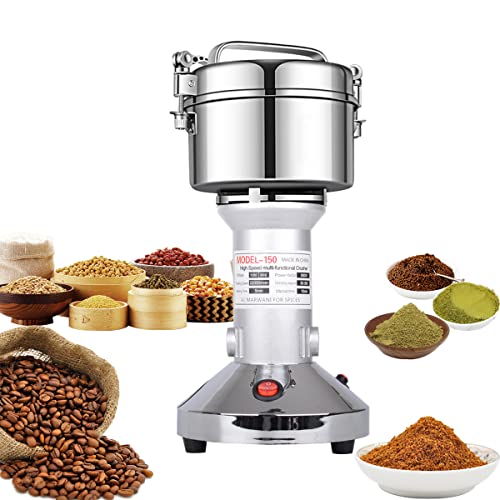
- 900W motor with 22,000 RPM speed
- Overload shutoff with reset button
- Grinds dry grains, seeds, nuts, and spices
Best For: Safety-conscious small-batch home use
High-Speed Stainless Steel Pick – 550g Electric Grain Mill
If you are comparing grain mills under 100, this compact electric model stands out for its 2000W motor, stainless steel construction, and broad dry-food compatibility. It can process grains, spices, herbs, and coffee, while its timer helps control the grind duration.
Best For: Home users who want fast, fine grinding for dry grains, spices, herbs, and coffee.
Pros:
- Food-grade 304 stainless steel construction.
- High-speed 2000W motor reaches 28,000 RPM.
- Adjustable grinding time supports roughly 70- to 300-mesh results.
- 550g capacity suits small-batch milling.
Cons:
- Designed for dry ingredients and should not be filled beyond two-thirds capacity.
- Continuous grinding should not exceed five minutes; cooling breaks are required.
- The machine should be wiped clean rather than rinsed.
This is a strong option when speed and superfine results matter, provided you are comfortable with short grinding cycles and manual wipe-down cleaning.
Traditional Manual Milling Pick – Victoria Cast Iron Grain Mill
Among grain mills under 100, the Victoria manual mill is a practical choice for shoppers who prefer durable cast iron and hands-on control. Its high hopper, adjustable screw, and table clamp support varied grinding tasks without requiring electricity.
Best For: Home cooks, brewers, and makers of coarse-to-medium meal, masa, and cracked grains.
Pros:
- Heavy-duty cast iron construction with double tin plating.
- Adjustable screw allows coarser or finer settings.
- 2,400g listed capacity and high hopper support larger batches.
- Clamp fits most tables 1/2 to 2 inches thick and includes a nonslip protector.
Cons:
- It cannot produce a superfine texture.
- It will not grind whole wheat into fine powder.
- Manual operation requires physical effort.
The Victoria is best viewed as a sturdy multipurpose hand grinder rather than a flour mill for powder-fine results. It makes sense for traditional preparations and coarse grinding where electricity-free operation is useful.
Safety-Focused Electric Pick – 550g Home Flour Mill
For shoppers evaluating grain mills under 100, this 550g electric model combines high-speed grinding with safety features and a generous accessory package. Its impact system handles dry, non-oily ingredients, while the timer offers control over coarse, medium, and fine results.
Best For: Home or small professional setups that need versatile dry-food grinding and included replacement parts.
Pros:
- 1800W rated power, up to 2700W load power, and 25,000 RPM blades.
- Overheating protection and a lid micro-switch improve operating safety.
- 30- to 300-mesh adjustment with a timer up to five minutes.
- Includes spare blades, a sieve, cleaning brush, and other replacement components.
Cons:
- Limited to dry, non-oily foods.
- The machine must not be immersed in water or liquid.
- Its 550g capacity is better suited to batches than continuous high-volume milling.
This model offers a well-rounded feature set for the price, especially if safety controls and included accessories are priorities. It is a practical choice for varied dry ingredients rather than oily or wet foods.
Authentic Hand-Crank Pick – Corona Cast Iron Grain Mill
If you are seeking grain mills under 100 without relying on electricity, the Corona manual mill offers a traditional cast iron design and a large hopper. Its adjustable grinding plates handle ingredients from corn and wheat berries to rice, coffee, spices, and dried peppers.
Best For: Home cooks making masa, tortillas, arepas, cracked grains, and adjustable coarse-to-fine grinds.
Pros:
- Heavy-duty cast iron construction with food-safe tin plating.
- Adjustable settings support coarse and fine textures.
- Includes hopper, hand crank, clamp, grinding plates, mounting hardware, and stabilizing pad.
- Clamp fits countertops up to 1.45 inches thick.
Cons:
- Manual cranking is slower and more labor-intensive than electric milling.
- The cast iron body weighs about 4.31 kg.
- Requires dry storage and cleaning after use to maintain its condition.
The Corona is a dependable traditional mill for users who value simple mechanics and versatile food preparation. Choose it for hands-on grinding and masa-making rather than maximum speed or automated flour production.
Best Compact High-Power Pick – 150g Stainless Steel Grain Mill
If you need grain mills under 100 for occasional home grinding, this compact electric model combines a 1500-watt rating with a 150g stainless steel chamber. Its three-blade design is intended for dry grains, spices, herbs, and coffee beans, making it a versatile choice for small batches.
Best For: Home cooks who want one compact grinder for dry grains, spices, herbs, and coffee beans.
Pros:
- Food-grade 304 stainless steel construction.
- Three-blade design supports grains, spices, herbs, and coffee beans.
- Compact 150g capacity suits small grinding jobs.
- Simple wipe-clean maintenance and storage.
Cons:
- Only for dry ingredients; the motor should not be washed directly with water.
- Continuous grinding should not exceed three minutes, followed by a cooling period.
- The 150g capacity may be limiting for larger batches.
This is a practical small-batch option among grain mills under 100, especially if you value stainless steel construction and broad ingredient compatibility. Its timed-use limits make it better suited to intermittent household grinding than heavy continuous processing.
Best Fine-Grind Value – 150g 750W Spice and Grain Grinder
For shoppers comparing grain mills under 100, this 150g electric grinder emphasizes fast, fine results in a compact format. Its high-speed motor, three-layer blades, and stated 70-300 mesh range make it suited to users who also want to process spices, herbs, coffee, and other dry materials.
Best For: Small-batch users who prioritize superfine grinding and a sealed stainless steel design.
Pros:
- Food-grade stainless steel body with a secure buckle structure.
- Three-layer blades support circular grinding.
- Rated for a 70-300 mesh crushed level range.
- Handles grains, herbs, spices, coffee, and several hard dry materials.
Cons:
- Its 150g capacity is not intended for large batches.
- Requires rest intervals after operation.
- Cleaning requires a cloth or brush rather than water.
This model stands out when fine powder consistency matters more than capacity. The compact chamber and dry-only design keep it focused on short grinding sessions, while the buckle lid and stainless steel construction add practical everyday usability.
Best Large-Batch Capacity – VEVOR 550g Commercial Grain Mill
If capacity is your priority when shopping for grain mills under 100, this VEVOR model offers a substantially larger 550g chamber and a 2000-watt high-speed motor. It is designed for dry grains, cereals, spices, coffee, and peppers, with a timer, safety features, and included sieve for more controlled processing.
Best For: Users who need larger dry-ingredient batches and want automatic lid and overload protection.
Pros:
- 550g capacity is larger than the other listed models.
- Three-layer blade system and 30-300 mesh grinding range.
- Automatic stop when the lid opens, plus overload protection.
- Includes a timer, brush, spare carbon brushes, and sieve.
Cons:
- Designed only for dry materials; wet, fresh, oily, and sticky foods are unsuitable.
- Requires five- to ten-minute rest periods after operation.
- At 7.3 pounds, it is less portable than the compact 150g models.
This is the strongest capacity-focused choice in the group. Its safety systems and accessories make it more feature-rich for repeated dry grinding, though the larger body and required cooldown periods are worth considering before buying.
Compact Power Pick – 150g High-Speed Grain Grinder
For shoppers comparing grain mills under 100, this compact electric grinder offers high-speed processing for small batches of dry grains, spices, herbs, and coffee beans. Its 850-watt motor and 150g capacity are suited to quick kitchen tasks, though the timed rest periods require a batch-by-batch approach.
Best For: Small households that need a versatile grinder for dry ingredients and occasional coffee grinding.
Pros:
- 850-watt motor and 27,000 RPM speed can process dry ingredients in about 30 seconds.
- Three-layer blade design supports grinding, powder removal, and finer results.
- Stainless-steel construction and a safety lid lock add practical everyday convenience.
- Works with grains, flour, herbs, spices, nuts, and coffee beans.
Cons:
- Small 150g capacity limits batch size.
- Designed for dry ingredients only and should not run continuously beyond the stated cycle.
- The grinding chamber should be wiped rather than washed directly with water.
This is a flexible, space-conscious option for quick small-batch grinding. Follow the fill limit and eight-minute operating cycle to get the most consistent use from it.
Large-Batch Workhorse – VEVOR 1000g Swing Grain Mill
Among grain mills under 100, this VEVOR model stands out for its 1000g capacity and commercial-style 3000-watt motor. The swing body helps with pouring and can promote more even processing, making it a better fit for larger dry batches than compact countertop grinders.
Best For: Users who regularly process larger quantities of dry grains, cereals, spices, or coffee beans.
Pros:
- Large 1000g capacity reduces the need for repeated batches.
- 270-degree swing design makes contents easier to pour out.
- 3000-watt motor and 28,000 RPM speed support fast pulverizing.
- Includes lid interlock and overload protection for added operating safety.
Cons:
- At 13.7 pounds, it is less portable than smaller grinders.
- Only suitable for dry materials; wet, oily, fresh, or sticky foods are excluded.
- Requires a five-minute operating limit followed by a 10-minute rest.
The VEVOR is the capacity-focused choice in this group. Its size and swing mechanism make it practical for frequent larger batches, provided you observe the short duty cycle and dry-material requirement.
Safety-Focused Value – 150g Dry Grain Powder Mill
For buyers seeking grain mills under 100, this 150g stainless-steel model combines quick dry-ingredient grinding with several protective features. Its 900-watt motor and triple-blade setup are designed for grains, seeds, nuts, herbs, spices, and coffee, while overload shutoff helps protect the motor during use.
Best For: Home cooks who want a compact dry grinder with overload protection and a broad ingredient range.
Pros:
- 900-watt motor spins at 22,000 RPM and can reach 50–300 mesh fineness.
- Handles dry grains, seeds, nuts, herbs, spices, and coffee beans.
- Overload shutoff and a reset button provide useful protection during operation.
- Snap-on cover, sealing ring, and non-slip base support secure handling.
Cons:
- 150g capacity is intended for small batches.
- Recommended operation is limited to three minutes before a five- to 10-minute rest.
- Wet, oily, or moist ingredients cannot be ground, and the chamber should not be rinsed.
This grinder offers a practical balance of versatility and safety for occasional home use. Its shorter duty cycle makes it less suitable for sustained processing, but the overload protection is helpful for small-batch work.
How We Picked the Best Grain Mills Under 100
We focused on models that offer useful milling performance at an entry-level price, including compact electric grinders and manual cast-iron mills. We compared stated motor power, grinding capacity, construction materials, hopper design, portability, and the range of dry foods each model is intended to handle.
Because specifications can vary by seller and batch, treat wattage and capacity as helpful reference points rather than guarantees of real-world output. A mill designed for occasional spices may not be the best choice for repeated batches of wheat or corn.
Quick Comparison
| Type | Best For | Main Advantage | Potential Trade-Off |
|---|---|---|---|
| Compact electric | Small batches of grains, herbs, and spices | Fast and easy to operate | Limited capacity and possible heat buildup |
| Large electric | Higher-volume dry grinding | More room per batch | Bulkier, louder, and harder to store |
| Manual cast iron | Off-grid use and hands-on milling | No electricity required | Slower and more physically demanding |
Key Buying Factors for Grain Mills Under 100
Capacity and Batch Size
Small 150g machines suit spices, herbs, oats, and occasional flour. A 550g model is more practical for family cooking, while 1000g-capacity machines are better for larger batches if you have enough counter and storage space.
Electric Versus Manual Operation
Electric mills save time and effort, but they can be noisy and may need rest periods between batches. Manual mills take longer but offer better control, work during power outages, and can be useful for homesteading or emergency preparedness.
Material and Cleaning
Stainless-steel grinding chambers are generally straightforward to wipe clean and resist rust when dried properly. Cast-iron mills are sturdy, though they require careful drying and occasional seasoning to help prevent corrosion. Look for removable or accessible parts if you regularly change between grains and spices.
Grind Use and Heat
Confirm that the mill is intended for dry ingredients. High-speed grinders can produce heat, which may affect delicate ingredients and flavor. Short pulses, smaller loads, and cooling breaks can help protect the motor and reduce overheating.
Noise, Stability, and Safety
Powerful countertop grinders are rarely quiet. Check whether the base sits securely, whether the lid locks firmly, and whether the controls allow safe operation. Keep hands and utensils away from the grinding chamber, and follow the manufacturer’s limits for continuous use.
Who Should Buy Which Grain Mills Under 100?
Choose a compact electric mill if you primarily grind small amounts of spices, herbs, oats, or flour and want the quickest workflow. Select a 550g model if you bake regularly and want a useful middle ground between capacity and storage. A 1000g electric mill makes more sense for frequent, larger batches, provided you can tolerate extra size and noise.
Choose a manual cast-iron grinder if reliability without electricity matters most, or if you prefer a traditional appliance that can handle occasional corn and grain milling with hands-on effort. For most first-time buyers, the best option is the model whose capacity matches typical batch size—not necessarily the one with the highest wattage.