When bench space is limited but samples need ultra-low-temperature storage, a compact freezer can look like the answer. The six models here are advertised at roughly 20–25 liters or 0.8 cubic feet, with claimed minimum temperatures near −86°C (−123°F).
Those numbers are only a starting point. Before buying, check whether a unit can reliably hold your required temperature under your lab’s conditions—and whether its controls, alarms, and documentation match the importance of what you plan to store.
Best 6 Laboratory Mini Freezer Picks for 2026
Best for Secured Sample Storage
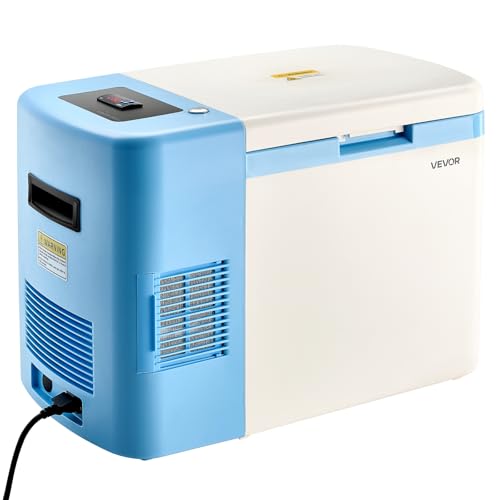
- 25L capacity; −40°F to −123°F range
- Customizable audible and visual alarms
- Keyed lock and stainless steel liner
Best For: Temperature-sensitive samples needing alerts and locked access
Best for Lighter Transport
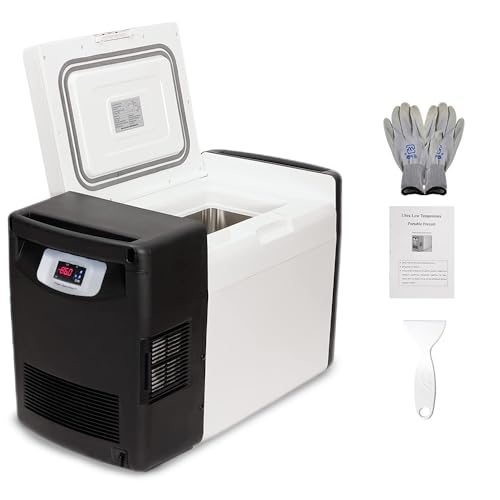
- 20L capacity and listed 46-pound weight
- −40°C to −86°C temperature range
- LCD display and stainless steel interior
Best For: Small sample collections where lower unit weight helps
Best for Optional Temperature Logging

- 0.1°C digital temperature adjustments
- Temperature and malfunction alerts
- Optional data logger sold separately
Best For: Labs wanting alerts with an option to add logging
Compact 20L Pick
Stainless Steel Ultra-Low Freezer

- 20L interior with 304 stainless steel liner
- Adjustable from -40°C to -86°C
- LCD display and microcomputer controller
Best For: Small-volume research storage needing ultra-low temperatures
Alarm-Equipped Pick

- 25L capacity; adjustable -40°F to -123°F
- Configurable audible and visual alarms
- Key lock and stainless steel liner
Best For: Compact lab storage needing temperature alerts and locked access
Probe-Port Pick
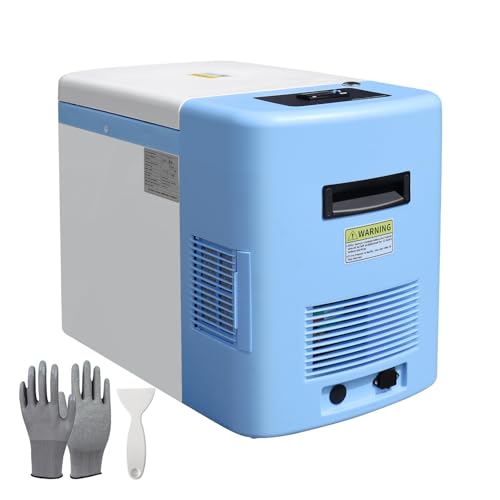
- Listed to reach -86°C (-122.8°F)
- 25L capacity with built-in handle
- Probe hole and silicone sealing gasket
Best For: Compact storage workflows using an internal temperature probe
Best for Secured Sample Storage – VEVOR 25L Ultra-Low Freezer
This laboratory mini freezer offers 25 liters of storage and an adjustable −40°F to −123°F range. Its digital controls, temperature alarms, and keyed lock make it a practical choice when both monitoring and access control matter.
Best For: Labs storing temperature-sensitive samples that need configurable alerts and a locking lid.
Pros:
- Microcomputer control allows 0.1°C temperature adjustments.
- Customizable audible and visual temperature alarms.
- 304 stainless steel interior and keyed lock.
Cons:
- At 63.9 pounds, it is heavier than the 20L model listed here.
- Its 26.4-inch width needs dedicated placement space.
The extra capacity and security features are useful if they fit your workflow; check the exterior dimensions before treating it as a countertop-sized unit.
Best for Lighter Transport – 20L 110V Lab Freezer
If you need to move a laboratory mini freezer between work areas, this 20L model weighs a listed 46 pounds. It offers a −40°C to −86°C temperature range, with an LCD display for checking the setting.
Best For: Labs seeking a relatively light, freestanding ultra-low freezer for small sample collections.
Pros:
- 20L capacity in a 46-pound unit.
- Microcomputer temperature controller with LCD display.
- 304 stainless steel interior.
Cons:
- Smaller capacity than the 25L VEVOR model.
- The listed 30.7-inch depth may limit placement options.
This is a sensible pick when weight matters more than capacity. The seller recommends leaving it upright and undisturbed for 24 hours after delivery before powering it on.
Best for Optional Temperature Logging – 0.8 Cu.Ft Cryogenic Freezer
This laboratory mini freezer pairs digital temperature adjustment in 0.1°C increments with alerts for abnormal temperatures or system malfunctions. An optional data logger, sold separately, offers a route to automatic temperature records.
Best For: Labs that want built-in alerts and the option to add temperature logging.
Pros:
- Digital controls support 0.1°C adjustments.
- Alerts cover temperature fluctuations and system malfunctions.
- Power-off memory and a three-minute compressor delay feature.
Cons:
- Data logger is not included.
- Requires manual defrosting.
- The supplied dimensions and 20L capacity are worth confirming with the seller before purchase.
Its monitoring features distinguish it from a basic compact freezer, but confirm the physical specifications and any logging accessories you need before ordering.
Compact 20L Pick – Stainless Steel Ultra-Low Freezer
If you need a laboratory mini freezer for a small quantity of materials, this 20L model offers an adjustable -40°C to -86°C range, an LCD temperature display, and a 304 stainless steel interior.
Best For: Research benches needing ultra-low-temperature storage in a 20L unit.
Pros:
- Adjustable -40°C to -86°C temperature range.
- Microcomputer controller with LCD display.
- 304 stainless steel interior.
Cons:
- 20L capacity may be too small for larger sample collections.
- Listing gives conflicting weights of 46 lb and 92.5 lb; confirm before planning to move it.
Its main appeal is the combination of a small interior and ultra-low temperature range. Check the weight discrepancy and available space before ordering.
Alarm-Equipped Pick – 25L Cryogenic Freezer
This laboratory mini freezer pairs a 25L capacity with an adjustable -40°F to -123°F range. Its digital display and configurable audible and visual temperature alarms give users a way to monitor conditions and respond to threshold changes.
Best For: Labs that want a compact ultra-low freezer with temperature alerts and lockable access.
Pros:
- Configurable audible and visual temperature alarms.
- Digital display and microprocessor temperature control.
- 304 stainless steel liner, key lock, and included maintenance tools.
Cons:
- 25L capacity limits how much can be stored.
- At 61.7 lb, it still takes planning to move despite its portable design.
Choose this model when alarms and a key lock matter alongside the ultra-low temperature range. Check that its 26.57 × 18.9 × 15.35-inch body fits your intended location.
Probe-Port Pick – 25L Ultra-Low Freezer
For workstations that need a laboratory mini freezer with a temperature probe opening, this 25L model lists a low temperature of -86°C (-122.8°F). It also has a silicone sealing gasket and a built-in handle.
Best For: Labs and other professional settings seeking a compact freezer with a probe hole for internal temperature monitoring.
Pros:
- Listed to reach -86°C (-122.8°F).
- Temperature probe hole supports internal monitoring.
- Includes keys, gloves, and a scraper.
Cons:
- 25L capacity may not accommodate larger storage needs.
- Supplied details do not specify an adjustable temperature range or built-in alarm.
The probe hole is the feature that most clearly distinguishes this model. If your workflow requires adjustable settings or an alarm, verify those capabilities before buying.
How We Picked These Laboratory Mini Freezers
We focused on the six selected compact models and the specifications most useful for comparing them: stated capacity, advertised temperature range, power requirements, interior materials, and listed controls or sealing features. Product names and listings are not proof of tested performance. We did not independently verify temperature stability, pull-down time, noise, energy use, alarm functions, or long-term reliability. Confirm those details with the seller or manufacturer before placing an order.
Quick Comparison
These choices fall into two overlapping size groups: units described as 25 L and units described as 20 L or 0.8 cu. ft. (about 23 L). All advertise ultra-low temperatures around −86°C (−123°F), but listings express the ranges differently. The VEVOR 25 L model and the other 25 L adjustable-range listing explicitly state a range beginning near −40°F; the 20 L listing highlights 110 V power. The remaining 0.8-cu.-ft and 25 L options emphasize features such as a digital display, compact or portable construction, or a sealing gasket. Similar capacities and temperature claims do not establish identical hardware or performance.
Key Buying Factors for a Laboratory Mini Freezer
Required Temperature and Stability
Start with the storage requirements for your specific samples, reagents, or materials. Check the continuous operating range—not just the lowest advertised temperature—and request data on temperature uniformity and recovery after door openings if those matter to your work. A displayed set point does not necessarily reflect the temperature of every item inside.
Usable Capacity and Installation
Compare internal dimensions, not just liters or cubic feet. Racks, boxes, and containers need room for airflow and safe access. Measure the intended location and check required ventilation clearance, ambient-temperature limits, door swing, and whether the unit can be moved safely when empty.
Power, Monitoring, and Support
Verify voltage, plug type, electrical draw, and any dedicated-circuit requirements for your facility. For valuable or irreplaceable contents, ask about high-temperature and power-failure alarms, remote monitoring compatibility, backup plans, service availability, and warranty terms. A digital display or silicone gasket alone does not establish these protections.
Who Should Buy Which Laboratory Mini Freezer?
Choose a 20 L model if its internal dimensions fit your inventory and minimizing footprint is the priority; confirm its stated 110 V requirement matches your site. Consider a 25 L model when the extra advertised volume makes organizing containers easier, but check actual interior measurements before assuming it holds more usable samples. If you need a particular adjustable range, compare the listings that explicitly specify approximately −40°F to −123°F and request operating documentation. If monitoring, validated performance, or dependable service is essential, make those requirements the deciding factors rather than choosing by the lowest claimed temperature or a portability label.